Burgertrippers: Days 7-8 The Twin Cities

(Read the intro post for background on this trip.)

Andrew (24) and I arrived in Minneapolis/St. Paul, Minnesota (aka “The Twin Cities”) yesterday. We’re spending two nights here as a bit of a rest plus it’s where I grew up, so I thought I’d torture Andrew taking him to all the random places I spent time as a kid. It’s also the first real burger destination on our trip.

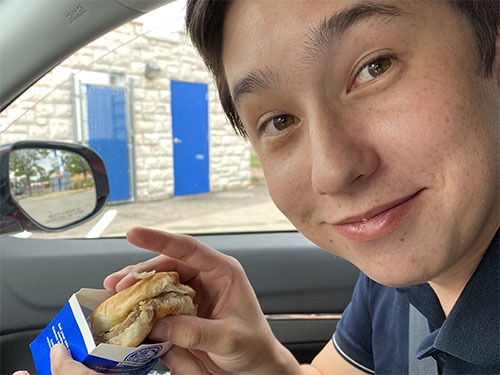
Our first stop was White Castle, the oldest fast food burger chain in the country, founded in 1921. This is a mostly Midwestern chain, so Andrew has never had one (we have stood outside the one in Las Vegas, but opted not to try it then because of the huge line of drunken gamblers). I had built them up to mythical status in my mind. White Castle burgers are unique; they are a small/slider-sized burgers with a super thin, square patty, topped with grilled onions and cheese optionally. The patty is steamed on top of a bed of onions; it has holes so they don’t have to flip the patty over. Each burger is served in a little cardboard holder. This was a disappointment to me; it was not nearly as good as I remembered – bland, too much bun (a little salt or ketchup would have helped though). Andrew actually liked it and came to the same realization that many, many others have: that a bag of these would be good after a night of drinking. The fries were ok, nothing special.

The White Castle burger
Andrew sitting in a car holding a little burger and its cardboard box.

We then went back to Woodbury, my home town, and saw my old house, elementary school, junior high, high school, each of my old friends’ houses, my places of employment, the hospital I volunteered in, and the shops I used to go to. Of course, each location included extensive stories and historical context. He was polite and did a good job pretending to listen/care.

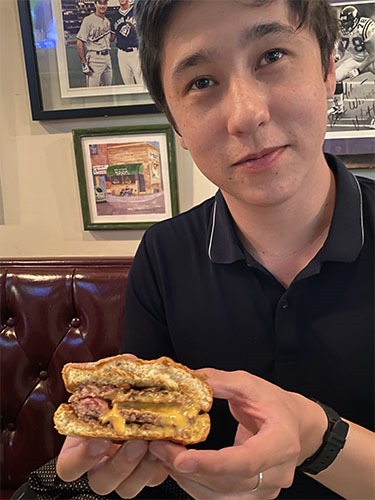
For dinner, we went to Casper & Runyon’s Nook, a neighborhood burger and beer restaurant open in since 1938. I tried their Juicy Nookie burger (their take on a Jucy Lucy – see below for more on that), and Andrew had their Triple B (Bourbon Bacon Burger). The Juicy Nookie had the cheese in the meat. The waiter and the menu warn patrons to let the burger cool a bit since the molten cheese will squirt out otherwise. This was a thick patty (really a double) with grilled onions on a toasted bun. It was very tasty – well grilled, well seasoned. Andrew’s Triple B was pretty good, but the bourbon barbecue sauce was too sweet. He didn’t actually finish his burger. We also had walleye fingers (deep fried nuggets of walleye pike: a local freshwater fish and one of my very favorite fish to eat) and “Nook Curds” – honey glazed deep fried cheese curds with bacon – decadent and delicious. The fries were once-fried cut potatoes – very good (but I [refer crunchier fries).

The Juicy Nookie
Andrew sitting in a restaurant booth, holding a burger cut in half to show a patty with a pocket inside and melted cheese oozing out.

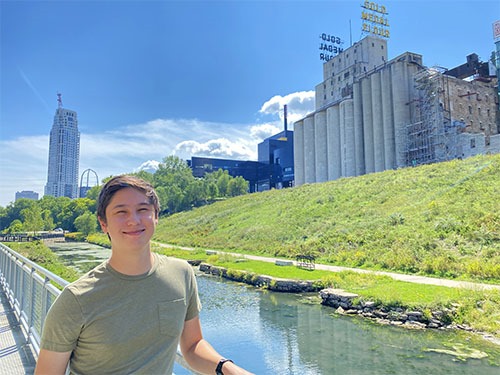
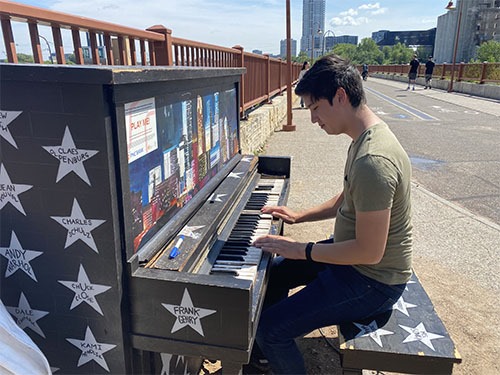
On Day 8, we needed a break from eggs and burgers, so we had dim sum at Mandarin Kitchen. It was very, very good – nice variety of dishes with good quality. It was better than most in Seattle. We then walked around the Mill District in Minneapolis. This is an area around St. Anthony Falls on the Mississippi River (the only major waterfall on the Mississippi) that used to have something like thirty flour mills and was the largest producer of flour in the world. It’s now been revitalized with museums, riverside parks, the Guthrie Theater, and walk ways. Andrew found a public piano (pretty broken actually) and gave an impromptu concert. I really like this area.The only bummer (to me at least) is that the Mill City Museum is still closed due to COVID. Fortunately, there are a lot of signs on the walkways nearby, so I learned a fair bit about the history of the area anyway. Andrew was politely patient, although he began mocking me a bit by pointing out signs I missed. I had originally planned to go to the Minnesota State Fair, which I loved as a kid, with special food memories – Pronto Pup corndogs (which I just learned are actually from Oregon), mini donuts, and the best strawberry ice cream ever at the Dairy Building. But, the prospect of being in a huge crowd of mostly maskless people on top of our existing travel risks wasn’t appealing. Oh well.

Andrew in the Mill District, in front of the old Gold Medal Flour mill
Andrew standing on a walkway in front of an old canal with a set of tall concrete grain silos behind him. A big sign saying "Gold Medal Flour" is on top of the silos

Andrew playing an upright piano painted with white stars and a mural. The piano is outside by a railing on the sidewalk.

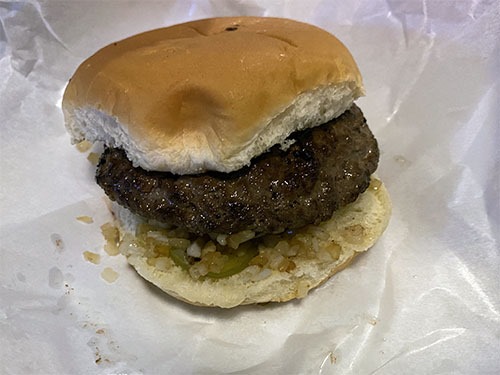
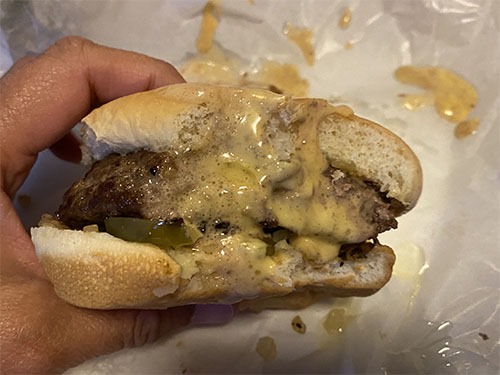
The main attraction of this stay in the Twin Cities was the Jucy Lucy burger at Matt’s Bar. This burger is famous enough to have its own Wikipedia entry and has been in the media a lot. President Obama even stopped by and had one. The Jucy Lucy has the cheese stuffed into the burger patty; the cheese is basically stuffed between two single patties. The edges of the patties are sealed to keep the cheese inside. The burger is simple otherwise, with just pickle chips and finely chopped and grilled onions on an untoasted bun. No sauces or condiments. It was perfect. Maybe the best burger of my life. The meat was good quality, well-seasoned, and well cooked. The cheese mixed with the burger juices and kept the burger moist. The finely cut grilled onion were a great complement; they didn’t overwhelm a bite like the bigger slices at the Nook. The bun-to-meat ratio was spot on. Every bite was absolutely delicious. An order of fries is huge, even for two people. They were pretty standard restaurant fries, but of course we ate them all. This dinner was especially special because we enjoyed with with my high school friend Stephanie and her son Soren. Good food is always better with good friends.

The Jucy Lucy – pretty straightforward and not fancied up for Instagram. Note the finely chopped onions.
A thick hamburger on a paper wrapper. The patty sits on finely diced grilled onions and a pickle chip.


The cheese and juices started oozing out after my first cautious nibbles.
jucylucy2


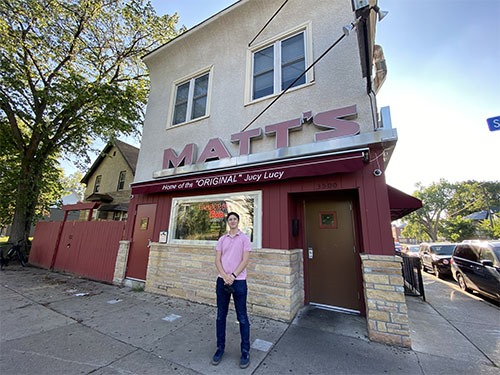
Matt’s is an unassuming neighborhood joint. The prices are still super reasonable ($8.75 for the Jucy Lucy) despite their fame.
matts


Burgertrippers: Day 6 Driving across South Dakota

(Read the intro post for background on this trip)

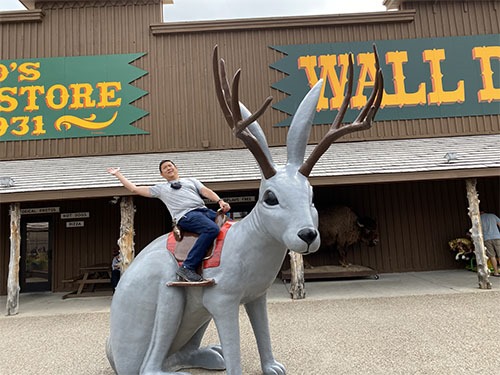
Andrew (24) and I kicked off our day at Wall Drug, the classic South Dakotan tourist trap destination. They were a little drugstore in the 1930s who started to advertise free ice water to drivers going to Mount Rushmore; the business took off from there. It’s even bigger and kitschier than I remember; this was Andrew’s first time. He enjoyed it though, and I got my free glass of ice water and “Where the heck is Wall Drug” bumper sticker. I also rode the fearsome jackelope

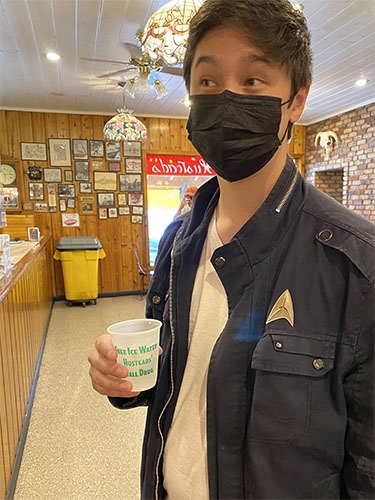
Andrew with free water
Andrew hodling a plastic cup of water that says "Free water Husteads' Wall Drug"

Me taming the jackelope
Tony riding a 10'+ tall jackelope model at Wall Drug


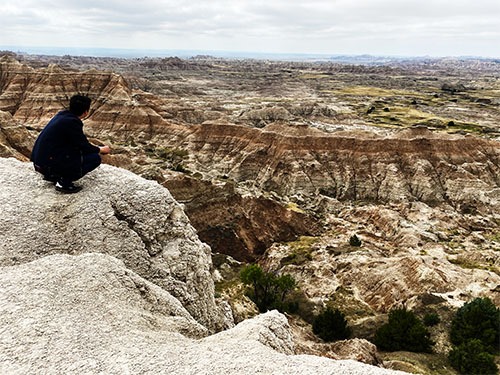
After we drank our fill of free ice water, we went to Badlands National Park (not the best naming…) This is a dramatic landscape of grasslands cut with deep, colored ravines and pinnacles. Andrew had never heard of the park but was super impressed.

Andrew surveying the Badlands
Andrew crouched on a ledge overlooking a rocky valley


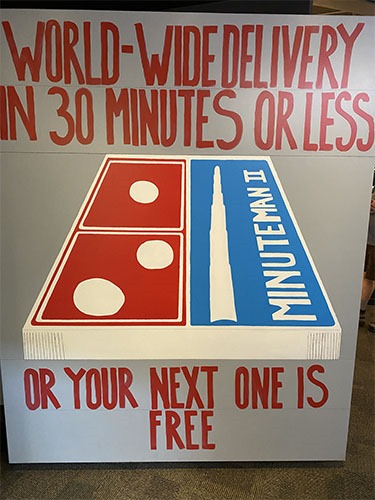
Just as we came out of the Badlands, we stopped at the Minuteman Missile National Historic Site.  This national site is located on what used to be a nuclear missile base housing ten Minuteman ICBM silos (since deactivated as part of the START II arms control treaty.) The little museum and theatre is solid. You can visit an old control room and a silo (both a few miles away), but apparently unless you make an appointment, there’s nothing really to see from the outside. We didn’t go see those.


Mural from the Minuteman control room
Mural saying "World-wide delivery in 30 minutes or less or your next one is free" and a Domino's pizza box with a Minuteman II label and image on it.


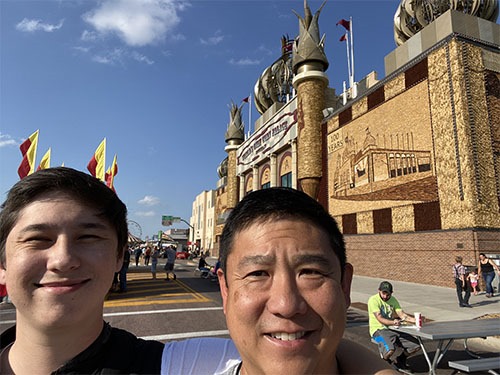
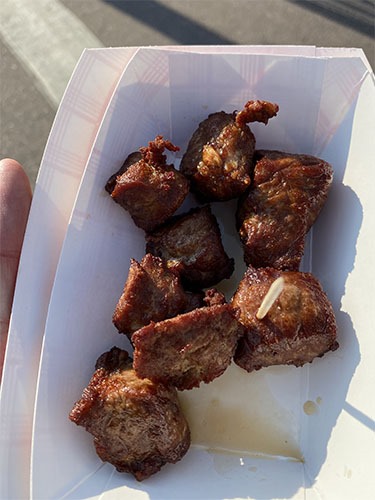
The next stop was the Corn Palace in Mitchell, South Dakota. I have strong memories of seeing the Corn Palace as a kid, so I figured it was worth a few minutes to swing by and see it again. They change the murals made of different colored corn each year, so it looked different (but kind of the same) than before. There was a fair on the streets around the Corn Palace, with games and food vendors. I took the opportunity to try chislic. This is dish of deep-fried cubes of red meat, classically mutton but often beef or game meats, eaten with a toothpick and served with saltine crackers. It’s a South Dakotan delicacy, even being declared the state’s “official nosh”. Deep-fried meat sounded right up my alley, but the version I had was only OK.

Andrew and me in front of the Corn Palace
Selfie of Andrew and Tony in front of a palace-like building covered in murals made from corn.


My first taste of (beef) chislic
Paper dish of fried meat cubes and a toothpick


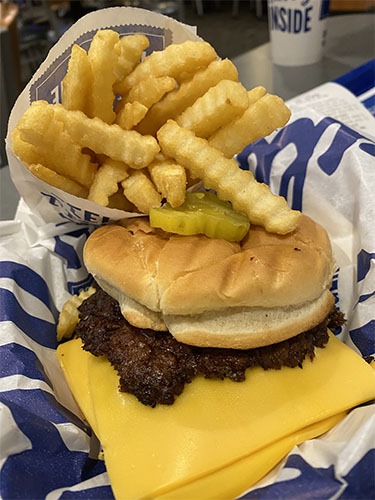
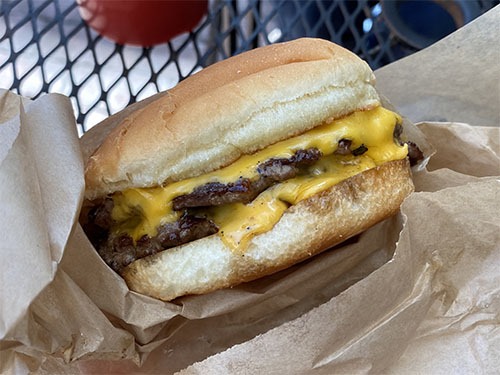
We finally got to Sioux Falls for the night. I don’t recall having spent any time in Sioux Falls before (I think my dad just drove past every time.) The falls area is very nice as is the revitalized downtown area. We also had our first regional burger chain of the trip – Culver’s. This is a mostly Midwestern chain (although they’re in 25 states now) famous for their Butterburger and custard ice cream. We figured anything named “Butterburger” must be good, so we gave it a try. The Butterburger is so named because they butter and toast the buns. It’s a smash burger using never-frozen beef. The patties are pretty thin, so the double was much better than the single, which was overwhelmed by the condiments (which you specify – we had ketchup, mustard, and mayo). The outside the patties was pleasantly crunchy and well-cooked, and the buttered and toasted bun was good. The cheese was not melted however. The crinkle fries were fine but nothing special. I liked the custard ice cream (especially the chocolate, which tasted like the old Frosty Malts at baseball games – definitely a nostalgic memory for me.) Their house-brand root beer was bland and boring. Overall, it was a great fast-food burger. I’d take it over any of the big burger chains, but In-and-Out beats Culver’s in my mind (although I’d like to try them side-by-side some day.)

Culvers Double Cheese Butter Burger and fries. Note the crispy patty edges and unmelted cheese.
Double burger with unmelted American cheese. Crinkle fries behind it.


Burgertrippers: Day 5 Devils Tower, Crazy Horse, and Mount Rushmore

(Read the intro post for background on this trip)

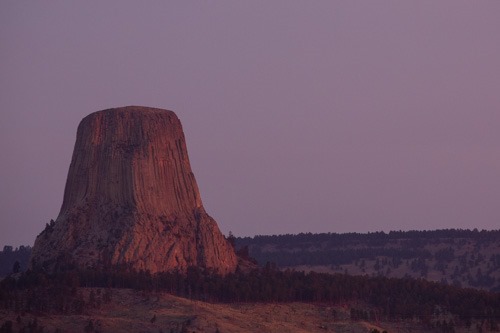
After a semi-rough night of sleep in the tipi due to the high winds, we got up at 5:45am to watch the sunrise and get to Devils Tower before the crowds.

Tall rock tower at sunrise with a purple sky

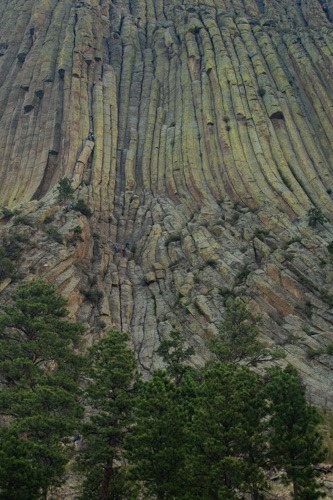
We got to the park and then did the 1.3 mile hike around the base. It was cool to see the tower up close and see how it different it was on each side. Up close, it’s really apparent that the tower is made up to columns of rock, some of which have calved away from the tower forming the rubble piles surrounding the tower, but apparently none has fallen in recorded history. Even though we were there early (before even the visitor center had opened), there were already climbers on the tower. The first climbers to summit the tower were two local farmers who did it in the 1890s as a publicity stunt, using a stake ladder. Wild.

Closeup view showing the columns of rock of Devils Tower. It looks like a tree trunk.

After our early morning hike, we semi-randomly picked a place for breakfast in Sundance, Wyoming. This is the town which gave the Sundance Kid his name but is not where the movie festival is. The Bearlodge Bakery turned out to be a really excellent restaurant; we both had an amazing breakfast burrito covered in green chile sauce. Sadly, today was their last breakfast service. The owner was closing the restaurant and trying to find a buyer. She can’t get enough long-term employees to sustain the business. Really sad.

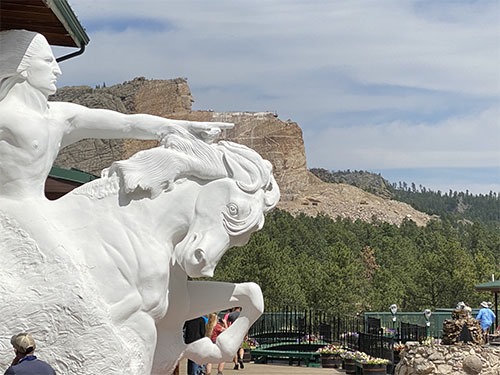
We then headed up to see the Crazy Horse Memorial and Mount Rushmore – two massive sculptures cut into the mountains. The Crazy Horse sculpture is still a work in progress. The last time I saw it (probably in the early 1980s) it was still being roughed out, with just a flat spot for the top of the arm and a hole under it. Now the face is complete and more of the sculpture is roughed out. You can see from this picture what the final sculpture is planned to look like and where the mountain is today.

Completed scale model of Chief Crazy Horse on his horse in front of the partially completed sculpture on the mountain

The project was started in 1949 but hasn’t taken any money from the US government. It’s progressing very slowly. I have to admire their tenacity though.

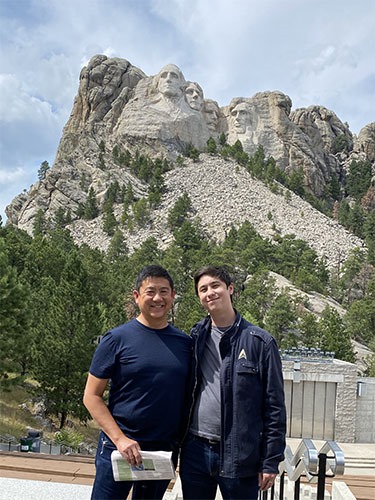
Nearby, the Mount Rushmore facility has improved a lot since I saw it last in 1990, with much more parking and a bigger/nicer visitor center. The museum provided more information how they actually did the work and how the artist had to keep redesigning the sculpture as he found weak rock (including having to destroy much of the original Thomas Jefferson sculpture). I also learned the government’s funding priorities due to World War II and the death of the artist resulted in not completing the original plan of showing the Presidents’ torsos. Regardless of what I might think about carving up mountains, I am impressed by the scale, audacity, and invention it took to create these.

Tony and Andrew standing in front of Mount Rushmore

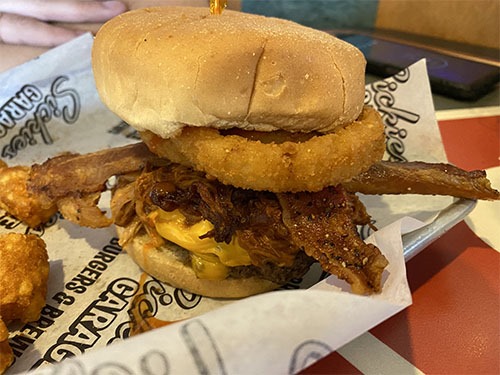
We spent the night in Rapid City, South Dakota. Since we didn’t have any planned burgers in Rapid City, a little internet sleuthing resulted in us going to Sickies Garage Burgers & Brews for dinner. The server mentioned they are famous for having a lot of different kinds of burgers, which they certainly do. Andrew had their eponymous Sickies Burger – a 1/3 pound burger with peppered bacon, fried egg, pulled pork, BBQ sauce, American cheese, an onion ring, and Frank’s Hot Sauce. I had a classic cheeseburger but made with an American Kobe beef patty. Both were excellent – good ingredients prepared with good execution. The meat tasted good, with a nice sear. The fries and tater tots we had were the standard frozen stuff, but they were fine. Sickies offers different seasonings for them like Cajun spice, so that’s nice. Super solid meal.

Andrew’s Sickie Burger
A cheeseburger with an onion ring on top, bacon poking out, pulled pork and cheese inside, on a lined baking tray with tater tots.

Burgertrippers: Day 4 Cody to Devils Tower

(Read the intro post for background on this trip)

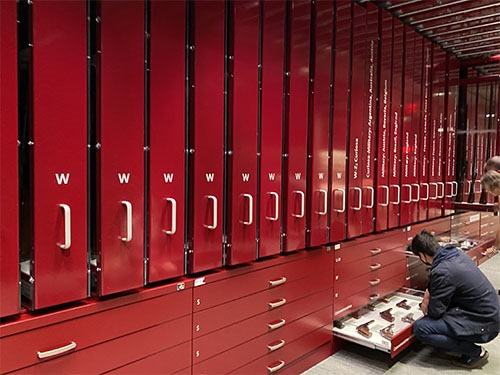
After a really good breakfast at our now-beloved Shoshone Lodge, Andrew (24) and I headed into Cody, Wyoming to visit the Buffalo Bill Center of the West museum. This complex is really five museums in one – the Buffalo Bill Museum, Plains Indian Museum, Cody Firearms Museum, Draper Natural History Museum, and Whitney Western Art Museum. We went through the Buffalo Bill, Plains Indian, and Cody Firearms museums. All of them were excellent – well curated with outstanding artifacts. I thought they handled potentially sensitive topics in a balanced ways. I didn’t know much about Buffalo Bill Cody going in, so it was super interesting and educational; he reinvented himself so many times and was pretty remarkable. The Cody Firearms museum was particularly impressive. It’s the largest publicly viewable firearms collection in the world. They have so many out that they have put many of them in drawers that visitors can pull out. I wish we had time to linger in the museums we visited and to see the others. I’d definitely come back if I’m in the area.

Rows of red vertical and horizontal pull out drawers loaded with firearms. Andrew is kneeling looking a pulled out drawer of handguns.


We then visited the Heart Mountain Interpretive Center, which is about 15 minutes from Cody. This museum is on the site of the Heart Mountain “relocation center” where 14000 Japanese-Americans were incarcerated during World War II without due process. Half were under the age of 18 and two-thirds were American citizens. It became the third largest city in Wyoming and had a bigger population that Cody does today.

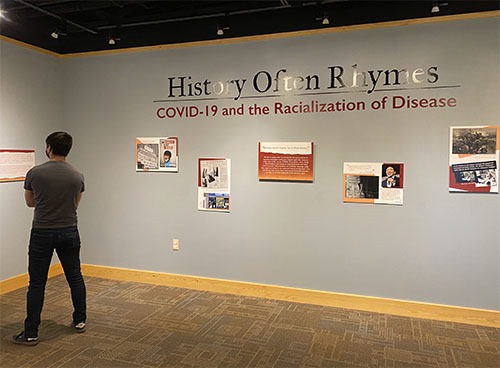
This is a subject I know a little about, especially since the first Japanese-Americans were shipped off to the camps from a dock about a mile from my house on Bainbridge Island, Washington. I still learned a lot; I was especially interested in the post-war phase, which most of the other accounts I’ve read don’t cover. There was a shortage of housing post-war for everyone, but it was especially tough for the Japanese-Americans coming back. They had lost everything, had little or no money, and often returned to racism and hostility. Even though almost all of the building from the camp are now gone, standing on the site was pretty emotional for me and brought the immense scale of the camp to life. The museum had a very timely special exhibit about how disease has been racialized throughout American history up to and including the current COVID pandemic. The whole museum made it super clear to me how easy it is for Americans to turn on each other during times of fear and hatred.

Andrew reading a museum exhibit wall with the title 'History Often Rhymes" and the subtitle "COVID-19 and the Racialization of Disease"


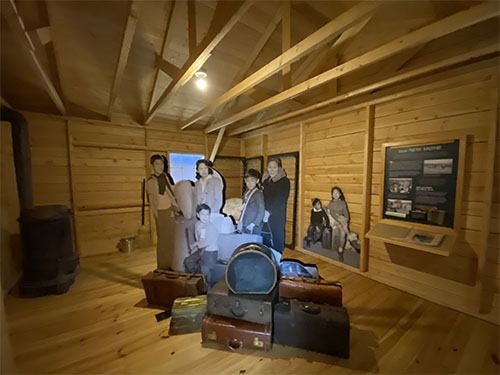
An exhibit showing how bare the incarceration camp barracks were when the Japanese-Americans first arrived.
A pile of luggage and lifesize photo cutouts of a Japanese American family in the middle of an empty, bare wood barracks.


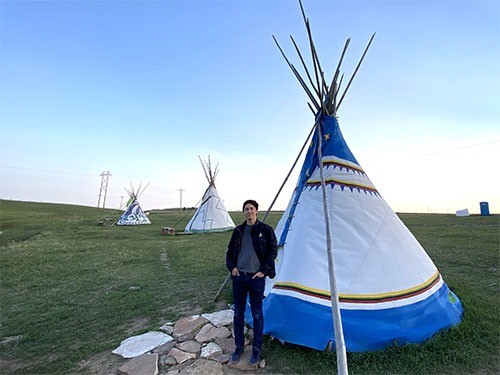
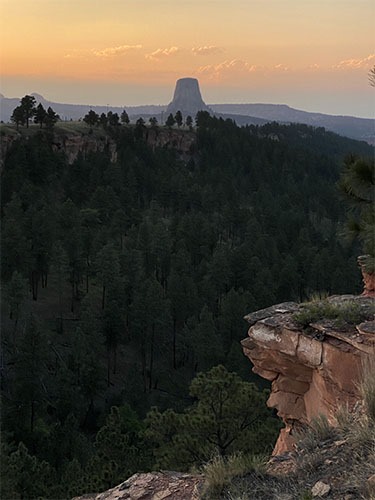
We then drove across Wyoming to reach our accommodations for the evening near Devils Tower, an AirBnB called Devils Tower Tipi Camping or Sunshine Crappy Fish. This was a super unique night for us, sleeping in a tipi with no running water or power. The camp is a few miles from Devils Tower with a clear view of the tower. One of the other guests gave us a great tip to walk over to a bluff nearby on the property to get a really incredible view of the tower, overlooking a ravine. That night we were also able to really see the stars and the Milky Way since there was so much less light pollution out here than most places we travel. We were also treated to a far-off lightning storm and thunder, which was pretty cool.

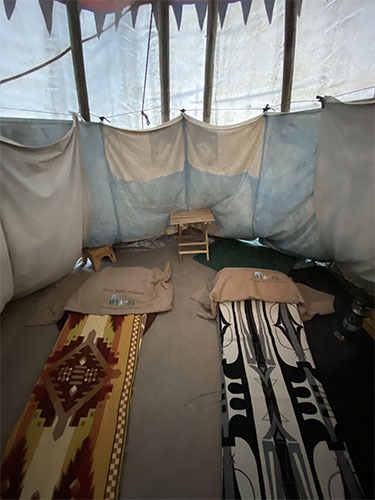
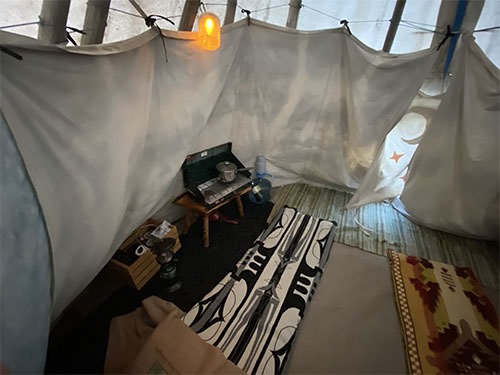
The tipi itself was warm and cozy. We slept on pads on the ground with blankets. The tipi came equipped with a propane stove, propane lamp, three gallons of water, mugs and instant coffee, and two solar lanterns. The only restroom on the site is a super clean Porta-Potty.The only real bummer was that it was a very windy night (20 MPH+), so the tipi fabric was noisy like any tent would be.

There are no dining options on-site and we arrived too late to really go to the any of the restaurants nearby. We were prepared and had brought a picnic lunch with us. No burgers for us tonight.

It was a fun place to stay and a great jumping off point to visit Devils Tower in the morning.

Andrew standing by our tipi
Andrew by tipis


Our sleeping arrangements inside the tipi
tipi inside 1


Our “kitchen” inside the tipi
tipi inside 2


The amazing sunset view of Devils Tower from the property.
Devils Tower view

Burgertrippers: Day 3 Yellowstone National Park

(Read the intro post for background on this trip)

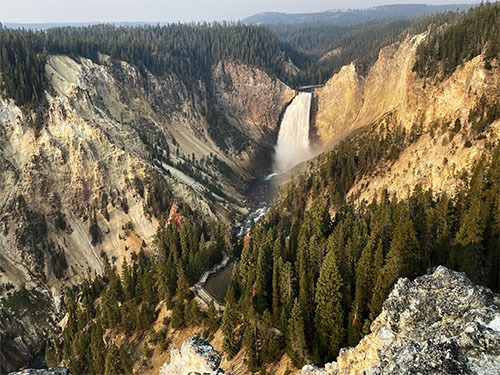
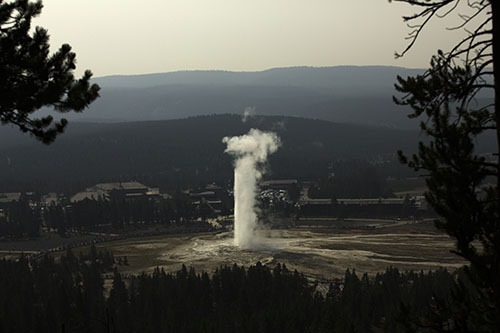
We spent our third day of the trip in Yellowstone National Park. This was Andrew’s (24) first time at Yellowstone, and my first time in in maybe 40 years. We entered through the north entrance at 6:45am to beat the crowds. We hit the Grand Canyon of Yellowstone, Grand Prismatic Spring, and the Old Faithful area plus a few other stops when we saw something cool. Of course, the park is stunning. I didn’t remember how diverse and other-worldly the different parts of the park are – gorgeous waterfalls and canyons, alien-like steam wafting out randomly, colorful geothermal pools, and of course, wildlife like buffalo wandering around. We mostly had the park to ourselves early on, but the traffic picked up over the course of the day. We had to wait for parking at Grand Prismatic and circle a bit for parking at Old Faithful, but we managed to avoid any big traffic jams (or buffalo jams!) At Old Faithful, we hiked up to Observatory Point for a different view of the geyser than usual.

Yellowstone Falls
A tall waterfall spilling into a valley with bare rock and tall trees


Old Faithful from Observation Point
A geyser erupting high into the air as seen from a high vantage. A big lodge is beyind the geyser


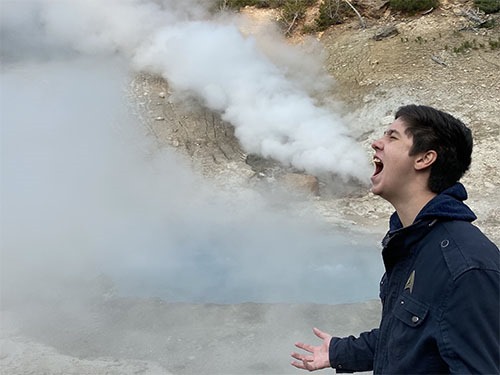
Andrew blowing off steam…
Andrew with steam billowing out of the ground behind him, looking like it is coming from his mouth.


We planned to stay in a lodge just outside the east entrance, but there was some mix-up with our reservations. Fortunately, they helped us find a room at the nearby Shoshone Lodge, which turned out to be a great place (and probably an upgrade). Dinner at the lodge was really good. Andrew’s “Bear Bite Burger” was a western-style burger topped with cheddar cheese, onion rings, and a spicy house-made huckleberry barbecue sauce. (The photo I took of the burger was terrible, and Andrew was too impatient to dig in for me to get a better one.) I had fried chicken for a change of pace. Both were excellent. Andrew described them as made with love. The meat was really good quality and tasted good, and the barbecue sauce was exceptional – spicy, sweet, tangy all in one.

We hung out around a campfire with some of the other guests for quite a while; some of the staff joined us later. It turns out, most of them are summer staff who found the job (and previous years’ jobs) on coolworks.com, which I had never heard of.) The other guests were interesting and from all around the country. It was a very enjoyable evening. The cabins at the lodge were basic but comfortable. The food and service are really what made it special. Andrew wants to go back.

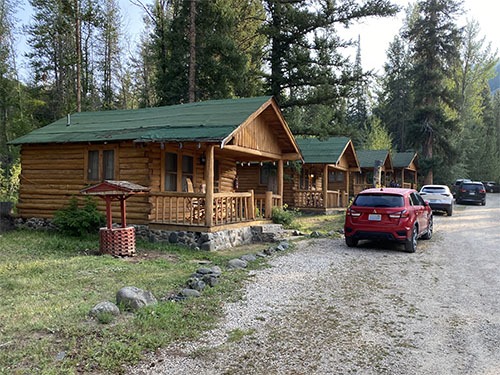
Shoshone Lodge cabins (ours was the first)
A row of small log cabins with cars parked in front

Burgertrippers: Day 2 Spokane to Gardiner, MT

(Read the intro post for background on this trip)

Andrew (24) got an early start today since we had about seven hours of driving today plus stops. We left Spokane and drove through Coere d’Alene, Idaho; it’s really pretty here with the mountains and big lake. We didn’t have time to stop, but I think it would be nice to come back.

We had hoped to try the Nutburger at Matt’s Place in Butte, Montana; this was one of the historical burgers we had really wanted to try. They cooked this burger on their original 1930s cast iron cooktop and topped it with chopped peanuts and Miracle Whip, which sounds odd but apparently worked. They had even won a James Beard award. Unfortunately, they’ve closed permanently. It looks like they had been for sale for a while including through June 2020; my guess is that no one wanted to buy a restaurant during the pandemic. Sad.

So, we kept driving through to Bozeman, Montana. My dad did his masters degrees at Montana State University there; it was also born there although I have no recollection since we moved away when I was two. Still, it was pretty cool to visit campus and walk around a little. It was crowded with students returning to school, so we didn’t want to brave the lines to buy a t-shirt. I’ll have to get one online.

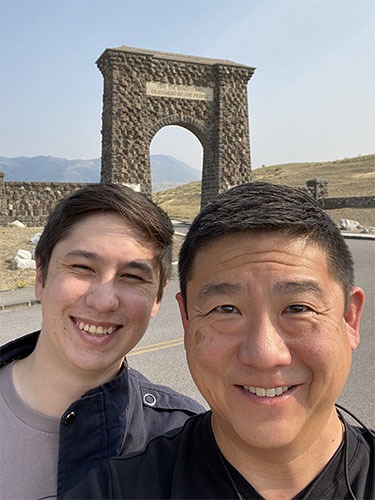
We finished up in Gardiner, Montana. This is at the north entrance to Yellowstone Park, where we will spend the day tomorrow. After walking around a bit and checking out the Roosevelt Arch marking the entrance to Yellowstone. (Interesting connection to Seattle – the arch was initially proposed by Hiram Chittenden who also was instrumental in the design of the locks in Ballard that are named for him.)

Andrew and Tony in a selfie in front of a rough brown stone arch

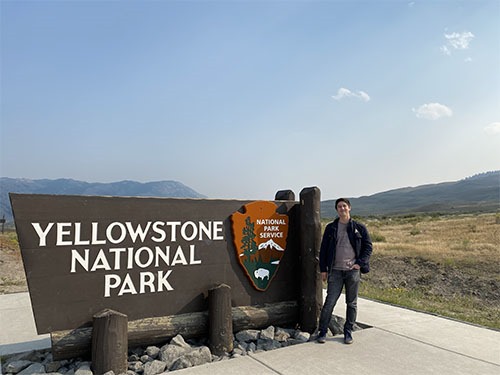
Andrew standing next to a large wooden sign saying Yellowstone National Park

After that we had dinner at the Iron Horse Bar & Grille. In line with our burger theme, Andrew and I tried the elk burger and the bison burger. Meh. The patties were thin but well cooked, with a little char on the outside for flavor. Both were dry and mostly similar to beef burgers, although the elk burger had a little more distinctive and gamey flavor. They listed brioche buns on the menu, but the ones that came out were more like ciabatta. The fries were commercially produced battered fries (the same ones as in one of the restaurants Andrew worked in), but I like them since they’re crispy on the outside and soft inside. Overall, the meal was ok but nothing memorable. The staff was friendly, and the outdoor deck overlooking the Yellowstone River and hills was nice (even though the air quality index was ~150, which is pretty bad and noticeable, presumably due to wildfire smoke.

Andrew with half of an elk burger and half of a bison burger at Iron Horse Bar & Grille

Andrew holding half a cut burger, the other half in a basket with fries, sitting outside on a deck

We hope to hit Yellowstone early tomorrow to get ahead of the crowds, so it’s an early night for us!


Burgertrippers: Day 1 Seattle to Spokane

Andrew (24) and I started out today from Bainbridge Island this morning in our rental Mitsubishi Outlander on our burger-hunting drive to New York. We dipped our hands in the Pacific Ocean (OK, Puget Sound, but it’s part of the Pacific Ocean) before we headed out. If we remember, we’ll do the same in the Atlantic when we finish our transcontinental drive. We then picked up our traditional McDonald's “adventure meal” breakfast. (When the kids were little, whenever we’d go on an “adventure” – a day trip to hike or go to a beach or ride the ferries or something) we’d get McDonald’s hashbrowns on the way. It became a bit of a family tradition. After taking the ferry to Seattle, we started driving east.

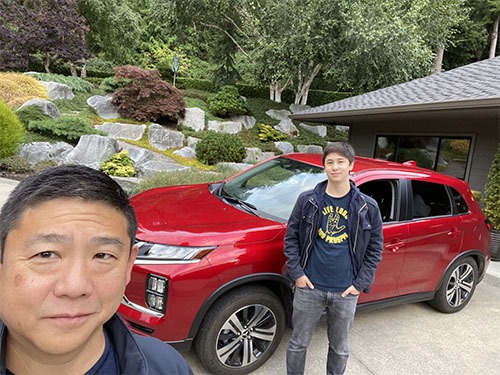
Selfie of Tony and Andrew in front of a bright red Mitsubshi Outlander SUV

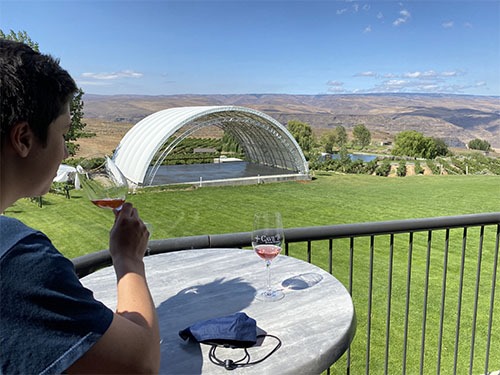
Our first stop was Cave B Winery in Quincy, Washington, about 2.5 hours east of Seattle. This was Andrew’s first wine tasting and my first trip to Cave B. It was a really nice place, with an outdoor patio overlooking the Columbia River Gorge. They have accommodations there, and it’s right next door to The Gorge Amphitheatre – an awesome outdoor concert venue. Andrew especially liked their Viogner. I liked their Cabernet Sauvignon. After the tasting, we drove a few miles into George, WA (really, that’s the name of the town) and had super tacos at Mi Lindo Guanojuato. This is a super friendly, pretty big but spartan Mexican restaurant and bar with amazing tortillas. Andrew and the owner had a pretty long conversation in Spanish, which seemed to impress and surprise the owner. (Andrew studied Spanish in high school but really became pretty fluent working in kitchens.)

Side view of Andrew tasting wine on a patio with a green lawn, domed concert venue, and Columbia River gorge behind him

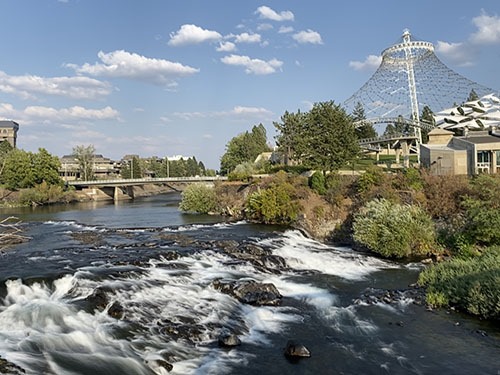
The rest of our drive to Spokane was pretty straight-forward although the air was a little smoky from wildfires. Andrew and I haven’t traveled much in eastern Washington and were impressed with the landscape. We were equally impressed by Spokane, which I haven’t been to as an adult. I think Andrew as there as a kid with Michelle, but he doesn’t remember. It’s a cute, clean city with a nice park/riverside area by the Spokane River. Riverside Park was originally the site of Expo ‘74, a world’s fair that somehow Spokane managed to land. The centerpiece the river and park are the falls and the former Expo pavilion.

Water fall/rapids in the foreground, pyramid shaped lattice pavilion on the right back

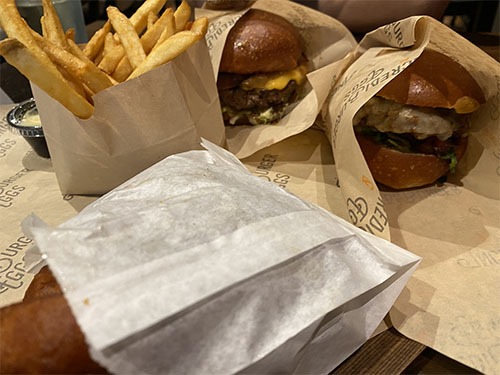
We didn’t have a historical or region burger to sample in Spokane (especially since the milk bottle shaped Mary Lou’s Milk Bottle restaurant was closed on Sundays). We decided on Incrediburger and Eggs (how could we pass up a place with a name like that?!) We ordered their PB&J burger, a classic burger (both with bacon, cheese, and grilled onions), beef fat fries, and onion rings. Both burgers were smallish, bigger than a slider but smaller than you might expect (which was fine since we were still pretty full from lunch).

The PB&J burger has peanut butter sauce, jalapeno jelly, cilantro, Thai aioli, and pickled peppers. I’ve always been a fan of peanut butter on burgers – it adds a nice richness. The jalapeno jelly cut the richness but wasn’t too sweet. The patty was nothing special – no real browning or seasoning. It was fine. The classic burger was straightforward and fine. I liked the brioche buns, but Andrew pointed out that these airy buns collapsed pretty fast, resulting in the wrong meat/bun ratio.

They make all their own condiments there, which was really a highlight. We thought these burgers showed how far you get making a tasty burger with just great toppings and condiments since the meat was only ok – basically just providing texture and warmth. The beef fat fries were the highlight. Fries cooked in animal fat are just way better than those cooked in vegetable oil. The onion rings were the big disappointment of the night. They were overcooked and bland with a heavy batter. They just tasted like burned batter. (Sorry for the bad photo – need to up my game on the food photography.)

Fries on the left, two burgers in brown wax paper on the right, and a bag of onion rings in front


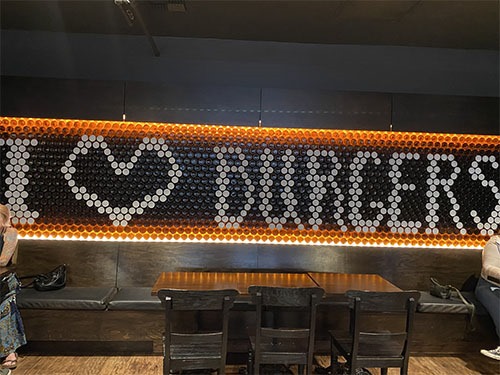
They did have wall art that seemed appropriate to start our trip. It was a good first day.

Wall art saying I (heart) BURGERS


Burgertrippers: Seattle baseline

  • Published Date:
  • by
  • Category:

Andrew (24) has been working fulltime in restaurant kitchens for the past five years and has decided that he wants to really make this his profession, so he’s headed to the Culinary Institute of America in Hyde Park, NY to get a degree in Culinary Science. He and I decided to take two weeks to drive across the country from Seattle to get there. On the way we’ll visit national parks, interesting little museums, and two cities I grew up in. But, the really interesting focus of our trip will be finding historically and regionally important hamburgers. Andrew researched the trip using the book Hamburger America plus some online work.

To set up for the trip, we decided to set a baseline using the best burger in Seattle, arguably Loretta’s Northwesterner. This is a tavern near Boeing Field, south of Seattle. We had both the double Tavern Burger (their specialty) and their Deluxe burger as well as fries.

Closeup of a double Tavern cheeseburger in brown wrapping paper

The double Tavern Burger was really fantastic, the stuff of recurring dreams since we visited. It’s a straightforward smash burger with crispy, well-browned patties. The bun-to-meat ratio is perfect and there were minimal toppings – just American cheese, pickles, chopped onions, and special sauce. It was just a super well executed burger (similar the way that In-And-Out is a just a good, well executed burger.)

Surprisingly, the Deluxe burger was nothing special, despite having lettuce, tomato, and red onion. The patty was a thicker burger (their menu calls it “restaurant-style”) vs. a smash burger; it was fine but not as flavorful. I suspect the meat was different (maybe frozen?)

The fries were very good too – fresh cut potatoes, well browned but not crunchy.

Overall, we learned that sharing burgers to try a few different ones is a good idea since the tastiness of the burgers can vary across the menu. We decided we would ask each place we go which burgers they’re famous for and try those. Loretta’s set a very high bar for our trip. I’ll definitely go back there.

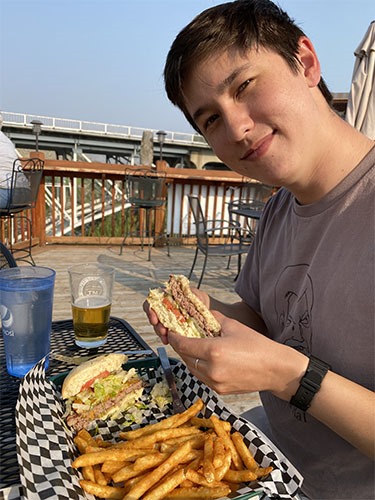
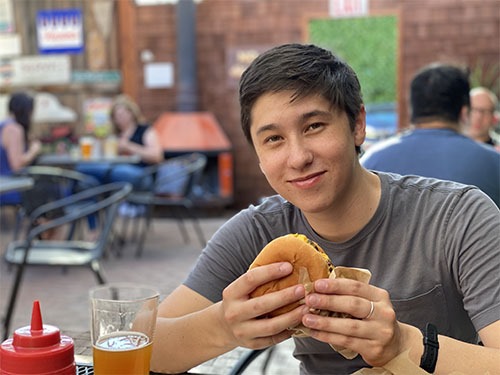
Andrew holding his burger, sitting on an outdoor patio, beer and ketchup in front of him

Trying my hand at shellfish farming

It’s been a while since I posted last. We moved to Bainbridge Island last December to a house on the water. I thought it would be fun to take advantage of this location by trying to grow oysters and mussels on our beach. (We have some piddock clams on the beach, but they’re hard to dig out of the rock and apparently not super tasty.) The Puget Sound Restoration Fund on Bainbridge sells oyster, clam, and mussel seed plus the gear you need to grow them each year in their annual seed sale. (Taylor Shellfish Farms does this as well, and they have more instructions on their site how to get started.)

To do this, you stake out a length of line between rebar stakes. You put the shellfish seed in plastic mesh bags and ziptie the bags to the line. Then, you let nature do it’s thing, with just some periodic cleaning and inspection of the bags. Theoretically, in 12-18 months, I’ll have eating-siize shellfish ready to go. I’m set out Kumamoto oysters, Pacific oysters, and mussels. We’ll see how it goes, but I’m kind of excited (since I love shellfish, as I’ve mentioned in posts for a while, like this.)

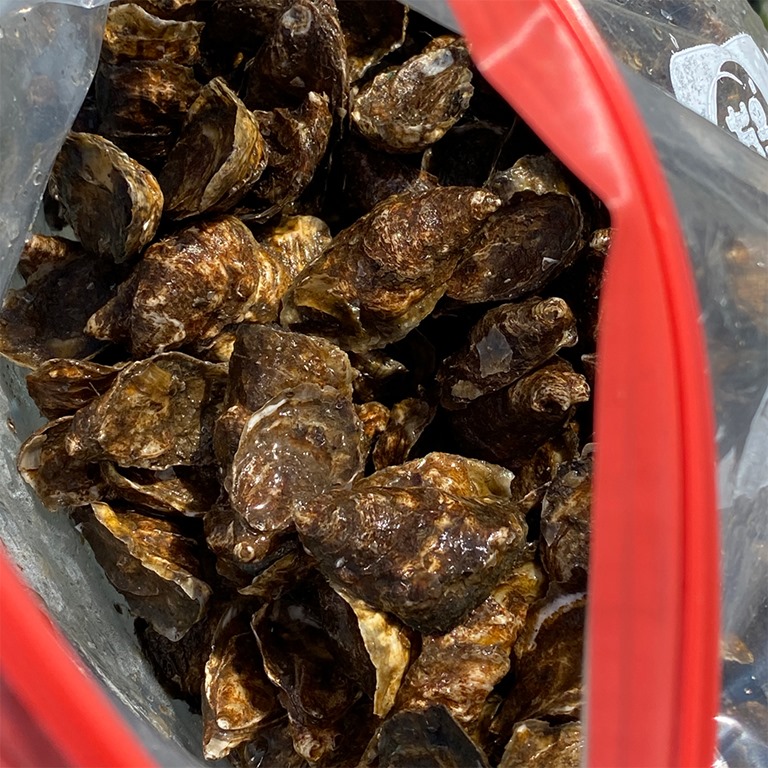
The oyster spat come in a gallon Ziplock. There are 300-400 oysters per bag. Here is a shot of the Pacifics in the bag.
oyster1


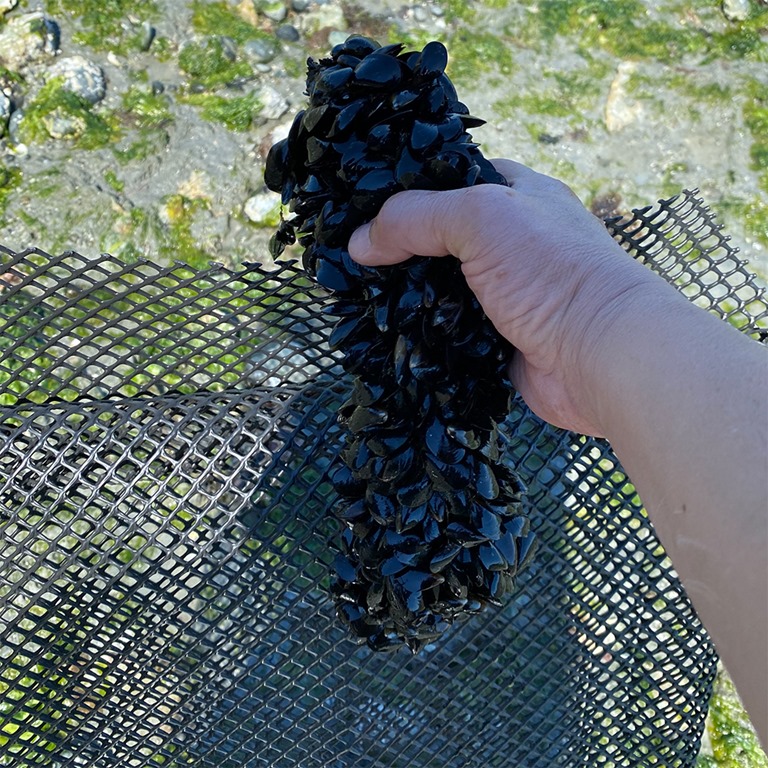
The mussels are attached to a length of rope:
mussels


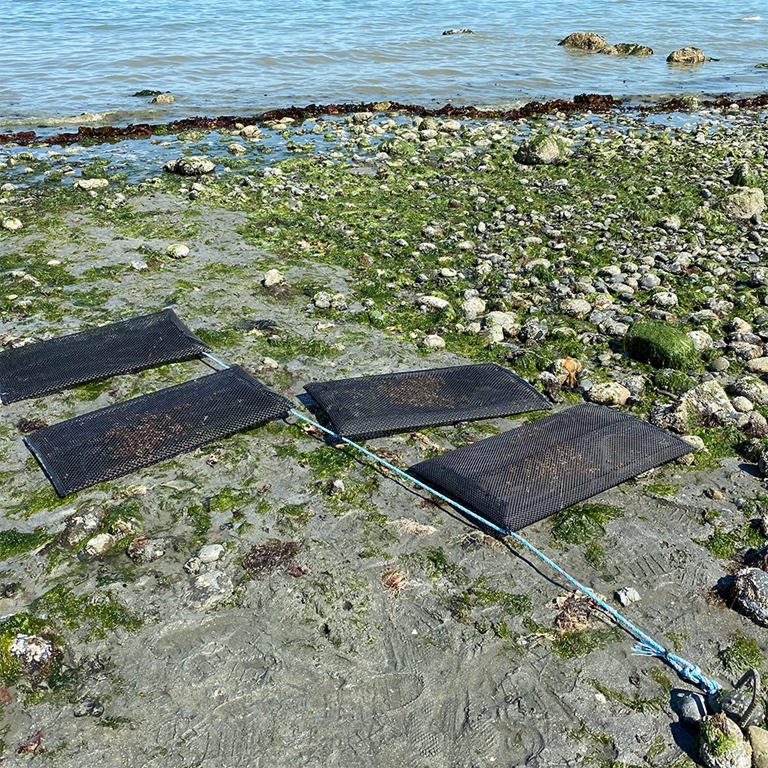
Here are the bags staked out on the beach, ready for the tide to come up.
oyster2

Tips for enjoying Tokyo


Tokyo is one of my all-time, very most favorite cities in the world. Everything you see is either the coolest thing you've ever seen or the weirdest. It's definitely worth going to multiple times. I've sent some variation of this note out to friends for years, so I figured I should finally just publish it. I'll update it as I visit and learn new things.

Getting around

Airports

There are two main airports for Tokyo: Narita and Haneda. Narita is the bigger international airport, but it's pretty far away (an hour by bus or train). Haneda is the older airport in town; it was recently refurbished so it's my first choice if you can use it.

If you fly into Narita, there are two good ways to go to/from the airport. Taxis are not one of them (very expensive and Narita is far from town.)

  • Narita Express (N'EX) - This is the train that goes from the airport to Tokyo Station and Shinjuku Station. From the train station, you can either take the subway or a taxi to your hotel, depending on how much luggage you have and your confidence navigating Japanese subways after a long flight. This is my favorite way to get to/from the airport during rush hour. I usually take this route when I arrive in Tokyo. Look for the JR East (Japan Railway) signs after you exit customs. You need to buy the ticket in the airport lobby then walk to the N'EX stop in the airport (maybe a ten minute walk). First class isn't worth the upcharge (just a little more legroom).
  • Airport Limousine Bus - This bus goes from the airport directly to your hotel. It's super convenient and the least expensive solution. The only downside is that it can be deadly slow in rush hour. I usually take this from the hotel to the airport. Buy the ticket from the concierge ahead of time to reserve space. Note, when you arrive at the airport, there will be a security check where police come aboard the bus and check passports. You MUST have your passport on your person, not in your luggage stored below in the bus. Also, don't lose your luggage claim tag since they'll check them as you pick up your luggage.

If I fly into Haneda, I usually just take a taxi into town and back, although you can also take the subway or Airport Limousine Bus. There are excellent restaurants upstairs on the outside of security. I especially love Ramen Setagaya.

Taxis

Taxis in Tokyo are excellent - clean and easy to find; they are, however, very expensive (about USD$10 just to get in.) Uber is available there too, although I haven't found the need to use it. Apparently, Line Taxi is more popular (since the chat app Line is super popular too.) One note: the driver will open/close your door via a lever. Do NOT close the door after you get into or out of the taxi since you may swing his lever and hit the driver. (Funny aside, taxi drivers around the world hate Japanese tourists because they leave their doors open.) Also, bring a taxi card or a note written in Japanese with your destination. Many drivers do not speak any English.

Subways/trains

Tokyo's subways are awesome and very on time. They're the best way to get around. They can, however, be confusing since there are several rail companies operating in the same stations. If you buy single tickets, you have to know which company to buy from and then use their station entrances/exits. You may also need to pay for transfer tickets. Ticket price is based on distance, so you need to know where you are and where you're going. Use the big maps to figure this out, but it can be time consuming to figure out. Most rides in town are 100-230 yen.

It's much more convenient to get a Pasmo card or a Suica card. These are stored value cards that you just swipe as you enter and exit the stations. This is much easier than trying to figure out how much your ticket price should be for each trip. You should buy a card at a subway station when you first arrive in Tokyo; you can get them from some of the ticket machines. Many stores (like the awesome 7-11s) and vending machines accept Pasmo and Suica cards for payment too. There's apparently some difference in which train lines accept which cards, but I've just used a Pasmo with no problem. The minimum first purchase is 1000 yen (~USD$10). You can add money to the card later as needed; the turnstyle will tell you how much you have left as you leave the station.

The subway stations are a cool tourist destination on their own, especially the bigger ones like Shinjuku Station (busiest train station in the world) or Tokyo Station. Lots of cool shops and excellent restaurants. They can be huge, so make sure you use the maps to figure out where you need to exit the station. If you pick the wrong exit, you could be very far from your destination or even on the wrong side of the tracks with no easy way to get across other than going back through the station. If you talk to someone at your destination (e.g. a restaurant) you should ask them which station exit you should use. During rush hour, the stations can be ridiculously crowded. This can be fun to see (e.g. Shinjuku Station on the Yamanote Line platform) or horrific. Plan accordingly.

Street addresses

The Japanese have the most f'ed up street addressing system. They seldom use the street name in the address and house numbers (if there's a number at all) are set by the order the building was constructed, not by the relative location on the block. Even when they rebuilt after WWII, they didn't fix the stupid thing. As a result, maps are critical. Most business cards for a restaurant, etc. will have a map. Make sure you get maps from the concierge.

You'll often see addresses in the form "5-5-8 Ginza, Chuo-ku, Tokyo". Important concept: Japanese name the block, not the street. "Tokyo" is the city. "Chuo-ku" is the ward. These aren't too helpful in this context. The first number is the district #. The second is the block#. The last is the building #.  "Ginza" is the sub-area in the district. You'll see the block numbers on street signs and on buildings. Here's a good visual explanation: http://sivers.org/jadr

Neighborhoods

Although Tokyo is one continuous, huge city, it is organized into wards and districts, similar to New York City's boroughs and districts. When you're talking about an place in Tokyo, you generally start by describing by ward or district (these are the places like Roppongi, Shinjuku, Shibuya, and Meguro that I mention below). More info from Wikipedia.

Hotels

I've stayed in a few hotels for work and personal trips.

  • Grand Hyatt Roppongi: Great place in the middle of Roppongi. Nice to get a room with club access for an easy breakfast or a drink after walking around all day. This is our go-to hotel in Tokyo.
  • Mandarin Oriental: This hotel is in Nihonbashi, an older, more business-y area of town. The hotel is on the top few floors of this 30+ story skyscraper. This is probably the nicest place we've stayed and the one we'd probably go back to again if not for the price. The restaurants are crazy excellent.
  • Four Seasons at Marunouchi: This hotel is in the center of town, between the Imperial Palace and Tokyo Station. The staff will pick you up from Tokyo Station and lead you back to the hotel if you like (it's that close). Service is impeccable, as you'd expect from a Four Seasons.
  • Cerulean Tower Tokyu Hotel: This is a good business hotel, super well-located a stone's throw from Shibuya Station. For people visiting Amazon Japan, this a convenient place to stay since it's just a quick subway ride to Meguro, where the office is.
  • Hotel New Otani: This is the grand dame of Tokyo hotels with a very 60s cool vibe; it's in Akasaka near the Imperial Palace. The fact it was in a James Bond movie (You Only Live Twice), has a beautiful garden, and has two Kyubei Sushi branches (see below) makes it especially great. The rooms are small but pretty up-to-date. I can't remember the difference between the Main tower and Garden rooms, so check reviews online before booking. I've frequently seen older Japanese women in kimono meeting in the garden restaurant/bar, which is cool to see.

I haven't stayed at the Park Hyatt in Shinjuku yet (made famous in the movie Lost in Translation), although I've had a drink there. Other friends have recommended it highly.

Places to Eat

Tokyo is one of my very favorite eating cities in the world. Restaurants in Tokyo almost always specialize in one thing (ramen, katsu, etc.) vs. serving a wide range of stuff like Japanese places in the US. Tabelog is the local equivalent of Yelp. Most of it is in Japanese, not surprisingly, but the reviews and photos may still be helpful. Yelp is there too. Most of the restaurants I list below have English menus (I've noted the ones that don't); the staff will have varying degrees of English, but you should be able to get by with pointing at the menus.

Ramen in Tokyo is awesome, as you might expect, with a lot of diversity of styles. Note, there can be a line at these places. It's common to get some gyoza (Japanese potstickers) and a beer with ramen. Some eat rice too, but that seems too filling and crazy to me.

  • Jangara Ramen: Rich, pork (tonkatsu) based broth, sometimes described as funky (this is Kyushu style). I always go back to Jangara. There are a few branches including one on Omotesando Dori (Ave) - nice shopping/tourist street). Here's my blog post. And another. There's another one in Akihabara, the electronics district - good for a bite if you're out electronics shopping. I seem to recall they only take cash, but that could be a mistake.
  • Ippudo Ramen: This is a lighter (than Jangara) style of pork broth, originally marketed for women. It is also amazing. There are several branches of this place too. This is my sons' favorite place. My blog post. There are Ippudo Ramen stores in San Francisco and NYC now (as well as other cities around the world).
  • Ramen Jiro: This is the advanced class, not for the faint of heart. Jiro has been described as the "Ramen Nazi" ala the Soup Nazi. It was even highlighted in an NPR story. This is a super thick, fatty, rich, amazing bowl of noodles with a cult fanbase. No English here, but then there's virtually no talking. You wait in line, buy a ticket from the machine to determine if you want a regular bowl, big bowl, and/or extra meat (get the low priced one - it's huge). Bring cash and coins for the machine. When you come up in line, sit down at the bar. You will not get to sit with your friends. Put the ticket on the bar. Just before you get your bowl, they'll ask you for options. You must reply in Japanese if you want vegetables/beansprouts (yasai), an extra ladle of pork fat dumped over your noodles - amazing (abura), and garlic (ninniku). When the bowl arrives, stick your face in and eat as quickly as you can. No talking. When you're done, put the bowl back up on the counter, wipe your place setting, and leave. Quickly. It's a bit intimidating, but it's a truly Japanese experience. Some people (including me) simply cannot get enough, others are grossed out by it. Here's a good step-by-step guide. There are several branches of this place too. My blog post
  • Menya Ishin: This is a special ramen place; their soup is chicken-based vs. the pork based broths almost everywhere else. They're in Meguro, near the Amazon offices, which is bonus for me. However, I don't think they have any English menus.

Katsu is also excellent. These are fried pork chops, sometimes served with Japanese curry (katsu curry) - one of my favorites.

  • Mai-sen: This is a famous shop with delicious katsu. The main shop is a few blocks in from Omotesando Dori. TripAdvisor write-up
  • Katsukura: This is my wife's favorite katsu place (she's always right...) It's on the 14th floor of the Takeshimaya Department Store (tall tower) in Shinjuku. Excellent and a different, more sophisticated vibe than Mai-sen.
  • Butagumi: Another excellent katsu place. We go here often since the Roppongi Hills location is pretty convenient. Bon Appetit write-up

Tempura (deep fried fish and veggies) in Tokyo is an art and way better than in Seattle. The most ridiculous places have Michelin stars and will set you back hundreds of dollars per person. In the interest of frugality, go to Tsunahachi. There are several branches.

Other places I love (in no particular order):

  • Morimoto XEX: This is a Michelin one star restaurant in Roppongi opened by the Iron Chef Morimoto. Crazy awesome steak house - good for your Kobe beef fix. Not cheap (at least USD$150-200/pp). I still dream about this meal though. My blog post.
  • Keyakizaka: This is another teppanyaki/steak place; it's located in the Grand Hyatt Roppongi. My family still talks about the Christmas meal we had there once. Andrew (21) hasn't ever liked fish (even in Japan) but he ate every morsel of fish he had at Keyakizaka. Another not cheap place though.
  • Inakaya: This is a fun robata-yaki place in Roppongi. You point at stuff you want to eat (fish, veggies, kebabs, etc.) and they grill it for you. Simple and tasty. No place like this in Seattle. My blog post.
  • Restaurant Kurosawa: (NB: closed as of November 2022) This is another one of our very favorite places. They make their own soba here (buckwheat noodles) but everything is done very precisely and well. Nice décor too. It's an homage to the Japanese film director by the same name. Right across the street from the Roppongi Grand Hyatt entrance. My blog post
  • Kyubey Sushi: This is a famous sushi chain with a few locations. Ideally, sit at the bar and order the omakase (chef's choice). You can keep eating until you're full, then wave him off. He'll put the "right" seasoning on each piece (a brush of soy sauce, a little salt, whatever). Don't dip into wasabi/soy here.
  • Harajuku Gyoza: We almost always stop at this gyoza (potsticker/dumpling) place for lunch when we're in Tokyo. It's delicious and pretty cheap. It's a good stop if you're checking out the Omotesando/Harajuku/Meiji Shrine area.
  • Breakfast buffet at the Mandarin Oriental: We've had many good breakfast buffets in hotels around the world, but this was the Tiger Woods/Serena Williams/Wayne Gretzsky/Michael Phelps of buffets - special among the special. I think it was technically in the K'Shiki Italian restaurant, but the buffet drew from all of the restaurants at the hotel (most of which I think are Michelin-starred or should be). Everything down to the eggs and milk were sourced from the best places around Japan and were miraculously tasty. It doesn't hurt that the restaurant and hotel enjoy crazy views since they're on the top few floors of a skyscraper.
  • Itadori Uogashi Senryo: This is a casual little place in the Tsukiji Outer Market (near the old fish market) that serves amazing mixed seafood bowls. I had their specialty: mixed seafood hitsumabushi. This is a big wooden bowl with rice and different kinds of sashimi. You first eat the rice and sashimi. Then, then they mix in sea urchin/uni, which adds a smoky depth. Then, then add soup to it to make a ochazuki (rice soup). Each phase is remarkable and delicious. We went for breakfast after touring the market. (Now that the fish market has moved, you probably won't be there as early, but it's still worth exploring the area and eating there.)
  • Sangosho Moana Makai: If you go to Kamakura, you must go to this beachside restaurant for the very best Japanese curry I've ever had. It's so ridiculously good that Michelle has spent years trying to replicate it. Their beef salad is almost equally memorable and definitely worth having too. They're super popular and don't take reservations AFAIK, so get in line before they open (and have your whole party with you). It's doubly good to go on a nice day since they have outdoor seating overlooking the ocean and beach.
  • KITKAT Chocolatory: This is a crazy little shop with fancy KitKat flavors (yes, KitKat candy bars). Upstairs is a ice cream shop/snack cafe where you can enjoy some of the KitKat flavors.

A few other things

  • "Draft beer" is "nama beeru". It will always be icy cold and delicious...
  • It's customary to say "ita daki mas" when someone brings you food.
  • Bakeries in Japan can be ridiculously good, especially for French-style pastries.
  • 7-11 has very good to excellent quick meals. Really. They are totally different in Japan and China than in the US. Hot deli food plus good refrigerated meals.
  • Yoshinoya is a good fast-food place with yakiniku beef (thin slices of marinated beef) on rice.

Other good things to eat - ask your concierge for recommendations

  • Shabu shabu: this is where you cook meat, veggies in a shared pot, like a fondue. Delicious.
  • Yakiniku: Korean-style grilled meat - grill at your table. Awesome.
  • Yakitori: grilled meat on skewers, like satays. I like the grilled chicken wings and grilled chicken meatballs. This is bar fare. Eat with beer and edamame (boiled soybeans). Definitely more casual.
  • Izakaya: Japanese bar food and just awesome. Kind of like tapas/appetizers with grilled/fried bits, sashimi, salads, etc.
  • Kaiten sushi: this is conveyor belt sushi. It's lower-grade/lower-priced sushi than places like Kyubey above, but better than most conveyor belt sushi in the US.
  • Coffee: The Brazilians (Columbians?) exported super high grade coffee beans to Japan early on, so the Japanese developed a taste for really good coffee. Find a good (expensive) coffee shop for a great cup.

Things to do

  • Tsukiji Fish Market area: The fish market moved recently (October 2018), but the area should still be fun to shop around the area - great shops with awesome knives, Japanese dishware (which we love), other food, etc. Also, fun to eat around the area, as noted above. Tekka-don (tuna sashimi over rice) is a common local dish - very fresh tuna indeed...(My blog post
  • Harajuku/Omotesando/Meiji Shrine: I lump these together because they're all close to each other, but they're really three things:
    • Harajuku - Start at Harajuku Station. On Sunday mornings, the kids come out all dressed in their cosplay - rockabillies, Lolitas, etc. There's a bridge by the entrance to the park where they seem to congregate. Turn right after you leave the station, as I recall.
    • Takeshita Dori (Street) is just across the big road from the station. It has more youth culture shops, etc.
    • Meiji Shrine - this is a lovely park with an old wooden temple. I almost always come here when I first arrive in Tokyo. It's a good place to walk around and be in nature after a long flight. My blog post 
    • Omotesando Dori (Ave): sometimes called the Champs Elysees of Tokyo. Nice (expensive) shopping street. Jangara Ramen, Maisen, and Harajuku Gyoza (listed above) are in this area. The Kiddyland toy store is here too.
  • Akhiabara: This is the electronics district. Tons of huge electronics and camera shops. Yodobashi Camera is the biggest, baddest camera shop. Bring your passport for duty free purchases. We like the video game arcades too.
  • Roppongi: Upscale area, more popular with expats. Big, upscale malls at Roppongi Hills and Tokyo Midtown (a few blocks from each other). Fun nightlife, but watch out a bit for the dudes pushing drugs. The Mori Art Museum is good too. We usually stay in Roppongi, hence all the restaurants above.
  • Asakusa: Fun area. I usually wind up here on most visits. There's a nice temple (Senso-ji) here plus lots of little shops/booths on the way up to the temple. Find a place making fresh sembei (rice crackers) - awesome. The guys on the central drag will be more expensive than on the ones off to the side, but heck, they're only a Y100 (~USD$1 so maybe you don't care...)
  • Imperial Palace: I've been here once. It's pretty; good for photos on a nice day. Good place for a run, but note that everyone runs in one direction (CCW) around the park. The entire loop is a 5K.
  • Shinjuku: Go out the east exit of the station (west is all office buildings) Lots of shopping here. Fun place to check out at night - pachinko, etc. The department store basements all have awesome food shops, like in England, etc. Takeshimaya is the most famous/best. There's a Starbucks, REI, and Microsoft office near the south entrance of the station, so it's sometimes called "little Seattle". Krispy Kreme is there too...
  • Shibuya: Busy shopping area. Lots of young people around. There's a famous, super busy intersection by the subway station, called Shibuya Crossing. Fun to watch. You can also watch from the two story Starbucks looking over the crossing. Be sure to visit the statue of Hachiko at the station. This is in honor the dog that used to meet his professor owner every day after work; even after the owner passed away, Hachiko kept coming back every day. The Mandarake shop in Shibuya is a well-known manga/anime shop; it's a basement overflowing with geeky goodness.
  • Kamakura: Nice day trip by train to get away from Tokyo a bit. The main draw is a big Buddha statue, but the town is good too.
  • Tokyo Disney: I've never been, but if you're collecting Disney visits, here you go. You can take the subway/JR line there.
  • Video games: ask the concierge to find you some video game arcades. Japan has way cooler games. I usually take my boys to a few in Shibuya. Some good ones in Akhiabara too. My blog post
  • Look at the vending machines. Although these are less fun than they used to be, you can find all kinds of crazy stuff in them including panty hose, full-sized bottles of wine, hot soup (Michael (18) especially loves the corn soup), etc.
  • Andrew (21) is a huge Gundam (big battle robots) fan, so a visit to the giant (60') high Gundam statue in Odaiba was a must. They've replaced the one we saw a few years ago with a new one.

Shops

  • Muji: This is a global phenomenon now and my family's favorite chain store. (I've also been to the Mujis in Beijing, San Francisco, Vancouver, New York City, London, Paris, Munich, and Madrid. I have a bit of a Muji problem.). They have great office supplies plus clothes (too small for all of us), housewares, small appliances, furniture, food, and even pre-fab houses. You'll see them all over Tokyo. Most will not have everything; the main store in Ginza is the best, but they're all awesome.
  • Sake Shop Fukumitsuya: This is a definite favorite of mine if you like sake and sakeware. Lovely, lovely sake glasses and pitchers. Excellent sake from the Fukumitsuya brewery, including aged sake - a rarity. They also have a sake bar. However, really no English spoken here. They have shops in Ginza and Tokyo Midtown. My blog post
  • Takeshimaya: Big department store chain and the first department store in Japan. You'll find everything here. The food court in the basement is gorgeous and awesome, although there's no place to eat there so you'll have to take away.
  • Kamawanu: There are a few of these shops that sell tenugui - printed fabric used for towels, gift wrapping, handkerchiefs, wall hangings, etc. These make great gifts. We almost always visit when we're in Tokyo; we use their tenugui all the time.
  • Yodobashi: The biggest, baddest camera store ever. Worth going just to see the accessories.
  • BIC Camera: The second biggest, baddest camera store ever.
  • Don Quixote: I'll admit, I don't love this dollar store as much as my wife does, but it's an amusing place to browse. Watch for odd products like face tissues/kleenex for men.

Cultural tips and other stuff

  • No tipping, except if you have a private tour guide
  • Hand over things like business cards and credit cards with two hands with the writing facing the person you're handing it to, so it's easy for him/her to read.
  • Receive stuff like business and credit cards with two hands. If you're receiving a card, read over the card thoughtfully. Treat the card as if it's the person, so put it away nicely. Don't shove it into your pocket.
  • Don't try to figure out the bowing thing. It's a very complex deal. A small nod is probably all you need.
  • In meetings the most senior person will sit in the middle of the table, like Jeff does. The most senior person from the other side will sit across (ala the hot seat). Seniority then sorts from the middle.
  • In meetings, junior guys may defer to the more senior folks. You may need to draw them out.
  • Remember that Japanese drive on the left side of the road, so watch out crossing the street.
  • Credit cards are pretty widely accepted now including in taxis, but some cash is good for smaller places.
  • Offices can be warm by US standards, so dress in layers.
  • Japanese shops will take great pride in wrapping whatever you buy very nicely. It's honestly a bit of a hassle since it takes a long time.
  • Enjoy the fancy electronic toilets. Here's a YouTube video explaining the buttons, since it can be a little intimidating the first time you encounter one. Note, the seats can be heated too, which is lovely but surprising the first time...