A Japanese Whisky Primer

I’ve been a fan of Japanese whisky for a long time (after overcoming my initial read that they were soulless), but I have struggled to get my head around all the category. So, with some help from ChatGPT, I decided to build myself a practical framework for understanding Japanese whisky. The goal is orientation rather than bottle collecting. My hope is to help you (and myself) to walk into a bar or shop, taste something once, and have a rough sense of where it fits.

(Me with the rare bottle of Yamazaki 18 Mizunara. Delicious.)
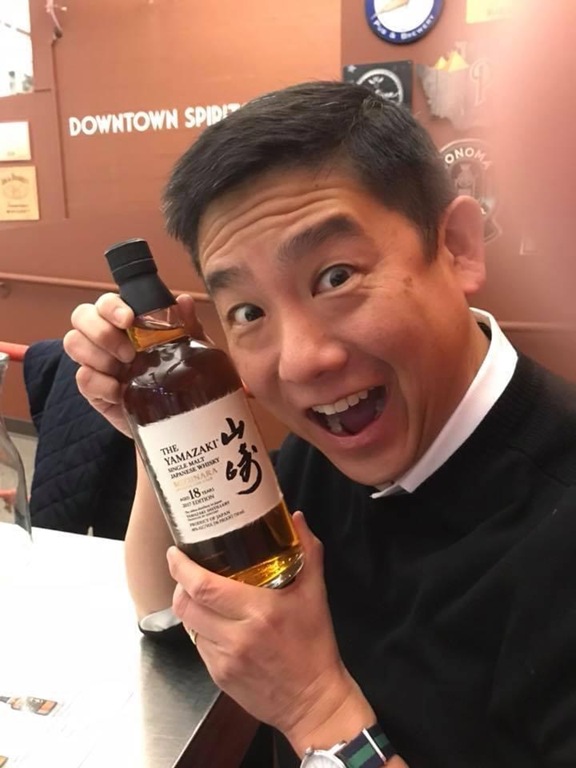
Tony with a big smile, holding a bottle of Yamazaki 18 Mizunara

First principles

Japanese whisky begins with Scotch technique but diverges in emphasis. It consistently favors balance over extremes, precision over power, and blending as a first class craft rather than a compromise. It is also meant to be a daily drink, not only a contemplative one reserved for special occasions.

If bourbon tends to emphasize sweetness, new oak, and immediate impact, and Scotch often emphasizes regional character, Japanese whisky emphasizes balance and integration, meaning how parts are chosen and assembled to work together.

One important caveat is that, for most of its modern history, there were effectively no formal legal rules defining what could be called Japanese whisky. Unlike Scotch, there was no long standing requirement that it be distilled, aged, or even fully produced in Japan. For years, some bottlings labeled as Japanese whisky included imported spirit or were distilled overseas and blended domestically. This does not mean those whiskies were bad, but it does mean the label alone was not a guarantee of origin. In 2021, The Japan Spirits & Liqueurs Makers Association published standards for labeling Japanese whisky, but the category is still better understood by producer reputation than by regulation. (Basically, the raw ingredients must be limited to cereal grains and water extracted in Japan, malted grains must always be used, fermentation/distillation need to take place in Japan, must be wood cask aged in Japan for at least three years, and bottling can only take place in Japan. Plain caramel coloring can be used.)

The framework

When tasting any Japanese whisky, three questions do most of the work. The first is how light or weighty the whisky feels, which speaks to body and structure. The second is how clean or smoky it is, which describes the overall flavor shape rather than specific tasting notes. The third is how it seems to be meant to be used, whether that is neat, with water, or in a highball.

The two pillars: Suntory and Nikka

Nearly everything a newcomer encounters traces back to two houses, Suntory and Nikka. Understanding how each organizes its distilleries and bottlings explains most of the category.

Suntory is generally elegant and restrained, with a strong emphasis on harmony. Its oldest and most famous malt distillery is Yamazaki, located near Kyoto. Yamazaki produces layered, classical whiskies built around fruit, spice, and oak. In the United States, the most commonly encountered expression is Yamazaki Distiller’s Reserve, with Yamazaki 12 Year appearing regularly in some markets but often at higher prices and in allocated quantities. Older age statements appear sporadically and at much higher prices. (I love the Yamazaki 18 and especially the Yamazaki 18 Mizunara, but those are hard to find and expensive.)

Suntory’s second malt distillery is Hakushu, set in a forested mountain environment. Hakushu whiskies tend to be fresh, herbal, and lightly smoky, with a bright, almost alpine character. Hakushu Distiller’s Reserve is generally the most consistently available Hakushu expression in the US market, while Hakushu 12 Year appears in waves depending on distribution and allocation.

Suntory also operates the Chita distillery, which produces grain whisky rather than malt. Chita whisky is clean, soft, and structural. It rarely takes center stage on its own in the United States, although The Chita Single Grain does appear occasionally. Its more important role is as the grain backbone of Suntory’s blends.

That brings us to Suntory’s house bottlings. Hibiki Japanese Harmony is not tied to a single distillery. It is a system level blend built primarily from Yamazaki and Hakushu malt whiskies, rounded and integrated with Chita grain whisky. The goal is balance rather than site expression. Suntory Toki is also a blend, but with a different intent. It leans more heavily on Hakushu malt for freshness, supported by Yamazaki for structure and Chita grain for smoothness. Toki is explicitly designed for highballs and everyday drinking.

Nikka, by contrast, tends to be firmer and more muscular, with a posture that often feels closer to Scotch. Nikka’s Yoichi distillery is located on the coast of Hokkaido and produces weightier whiskies with peat and maritime influence. Yoichi Single Malt is the flagship expression most commonly seen in the US.

Nikka’s other main malt distillery is Miyagikyo, located inland in a river valley. Miyagikyo whiskies are softer and fruit driven, with rounded edges and a more polished feel. Miyagikyo Single Malt is widely available and serves as a counterpoint to Yoichi.

Nikka also produces grain and malt whiskies on Coffey stills, which are continuous stills rather than pot stills. Both Nikka Coffey Malt and Nikka Coffey Grain are distilled primarily at Miyagikyo. Coffey Malt uses malted barley but has the texture and sweetness people associate with grain whisky, while Coffey Grain is made largely from corn and often feels bourbon adjacent. Nikka Coffey Malt is one of my favorite everyday drams. The Nikka Whisky from the Barrel blended whisky is also a personal go-to.

A simple taxonomy

Before going further, it helps to understand why Japanese whisky suddenly became scarce and expensive. Around the early 2010s, roughly 2013, Japanese whisky experienced a sharp spike in global attention and demand. International awards, enthusiastic Western press, and a few high profile bottlings combined to push Japanese whisky from a domestic staple into an international luxury object. The problem was that whisky being sold in 2013 had been distilled a decade or more earlier, at a time when producers had scaled down production due to low domestic demand. The resulting mismatch between supply and demand emptied warehouses quickly.

The effects are still visible today. Age statements disappeared, prices climbed, and many whiskies that were once everyday bottles in Japan became export constrained. Understanding this history helps set expectations. Japanese whisky was not designed to be rare. It became rare because it was unexpectedly successful.

Another way to say this, without introducing new rules, is that Japanese producers think in terms of function rather than hierarchy. Single malts tend to express place, such as Yamazaki, Hakushu, Yoichi, and Miyagikyo. Grain whiskies tend to provide structure and continuity, with Chita on the Suntory side and Coffey Grain or Coffey Malt on the Nikka side. House blends tend to express intent, bringing components together to achieve a specific balance or use case, as seen in Hibiki, Toki, and Nikka From the Barrel.

An orientation map

Rather than scores or rankings, it is more useful to think of Japanese whisky along two simple axes. One runs from light to weighty and describes body. The other runs from clean to smoky and describes overall flavor shape.

On the lighter and cleaner end sit bottles like Suntory Toki and Nikka Days, which emphasize refreshment and ease. Hakushu Distiller’s Reserve still feels light but introduces more character through herbs and a trace of smoke. Yamazaki Distiller’s Reserve and Hibiki Harmony occupy the middle ground, with moderate body and a generally clean profile. Yamazaki 12 sits just above that midpoint, adding more depth, oak integration, and length without moving far toward smoke. Hakushu 12 adds more smoke without becoming heavy. Miyagikyo Single Malt moves toward the weightier side while remaining relatively clean, while Yoichi Single Malt sits at the weighty and smoky end of the spectrum.

Mizunara oak

Mizunara oak plays a specific and often misunderstood role in Japanese whisky. Mizunara is a species of Japanese oak, native to Japan, and distinct from the American and European oak more commonly used in whisky making elsewhere. It is extremely porous, difficult to season, and prone to leaking, which makes it expensive and frustrating for distillers to work with.

When it works, Mizunara contributes aroma more than structure. It can suggest sandalwood, incense, coconut husk, old wood, or temple like notes that are closely associated with Japanese whisky in the popular imagination. These characteristics tend to emerge slowly and are often most apparent after long aging. Because of its fragility and assertive aromatic profile, Mizunara is rarely used as the sole maturation vessel. In most cases it appears as a component or finishing element rather than a foundation, adding a distinctive accent rather than defining the entire whisky. I personally love Mizunara aged whisky. Bainbridge Organic Distillers here on Bainbridge Island, WA (where I live) uses mizunara extremely well. Their Yama is the only non-Japanese whisky aged exclusively in Mizunara oak and is an exceptional bottle. They also make a really great bottle called Two Islands Mizunara Cask Whiskey, which has a second aging in single-use Mizunara casks (and is much less expensive than the Yama.)

A note on modern brand‑led Japanese whisky

As Japanese whisky gained global attention and legacy producers ran into hard limits on mature stock, a parallel category emerged alongside the traditional distillery system. These are brand‑led Japanese whiskies that emphasize sourcing, blending, maturation, and finishing choices rather than the voice of a single distillery. Whiskies such as Shibui, Sensei, Kurayoshi, and The Mikuni fit here.

These bottlings are best read as expressions of intent rather than place. They are typically built to be approachable, export‑friendly, and stylistically legible as “Japanese,” often leaning on polish, balance, and, at times, Japanese oak as a signal. That does not make them illegitimate, nor does it place them in competition with Yamazaki, Yoichi, Komagatake, or Chichibu. They are answering a different question. Instead of asking what a particular site tastes like, they ask what Japanese whisky should feel like to a global drinker.

Understanding this distinction prevents confusion. Distillery‑anchored whiskies teach you geography, climate, and production philosophy. Brand‑led whiskies teach you how Japanese whisky aesthetics have been translated outward as the category expanded. Seeing them as complementary rather than interchangeable makes the modern Japanese whisky landscape far easier to navigate.

The highball

A highball is a simple mixed drink made by combining whisky with chilled carbonated soda water over ice, usually in a tall glass. In Japan, highballs are central to whisky culture rather than secondary, and understanding how they are actually drunk changes how Japanese whisky itself makes sense. In Japan, the highball often plays the social role that beer plays elsewhere. It is refreshing, low friction, and meant to be consumed with food, conversation, and repetition rather than contemplation. In that sense, yes, it functions very much as a beer replacement, especially in izakaya and casual bars where people might drink several over the course of an evening. We’re big fans of Toki highballs in my household.

A standard Japanese highball is more precise than it looks. Ratios are usually conservative, often somewhere between one part whisky to three or four parts soda, depending on the house style and the weight of the whisky. The glass is fully chilled, the ice is hard and clear to minimize dilution, and the soda is added gently to preserve carbonation. Many bars use strongly carbonated soda water such as Suntory Soda, Wilkinson, or similarly aggressive carbonation. The goal is lift and snap rather than sweetness.

A thin lemon slice or lemon peel is common but not universal. When used, it is meant to brighten aroma rather than turn the drink into a citrus cocktail. The lemon is usually expressed lightly or simply dropped in, never muddled. Some bars omit citrus entirely for cleaner whiskies, especially Hakushu based highballs, where freshness comes from the malt itself.

At the higher end, the highball becomes a study in restraint rather than extravagance. Better bars adjust ratios slightly upward, use hand cut ice, and choose whiskies with enough structure to survive dilution. Yamazaki, Hakushu 12, or even Hibiki are sometimes used, not to show off but to demonstrate how balance changes when stretched. In these cases, the drink is often stirred once or twice and left alone.

At the higher end, another common way of drinking whisky appears alongside the highball, known as mizuwari, which is simply whisky diluted with still water, often close to a one to one ratio. This is not about weakening the whisky but about opening it. Dilution lowers alcohol heat, releases aroma, and makes it possible to drink whisky slowly over a meal. Good bars adjust the ratio by feel, often adding water first, then whisky, and stirring gently to integrate rather than shock the spirit. Mizuwari is especially common with more structured whiskies like Yamazaki or Yoichi, where added water reveals fruit, spice, and texture that can be obscured when tasted neat. In colder months, some drinkers switch to oyuwari, which uses hot water instead of cold to emphasize aroma and softness, particularly with fuller bodied whiskies.

Suntory Toki, Hakushu Distiller’s Reserve, and Nikka Days all excel in highballs, and they were designed with this role in mind. Suntory even deploys dedicated Toki highball machines that pre‑chill, carbonate, and ratio the drink consistently, reinforcing the idea that the highball is engineered rather than improvised.

Judging these whiskies only when tasted neat misses an essential part of what they are meant to do.

A practical starting point

For fast calibration, a small set of bottles goes a long way. Toki establishes a highball baseline. Yamazaki Distiller’s Reserve shows a clean, composed single malt. Hakushu Distiller’s Reserve introduces freshness and light smoke. Yoichi provides a Scotch-adjacent anchor. Hibiki Harmony demonstrates Japanese blending at its most polished. Nikka From the Barrel shows what happens when that restraint is turned up a notch.


What are your favorites? Share your tasting notes in the comments!
New World’s Best Vacation Ever: Velaa Private Island

  • Published Date:
  • by
  • Category:

Fifteen years ago, I wrote about what I thought was the best vacation we had ever had: Pulau Pangkil, a private island in Indonesia. Even today, we still think very fondly on Pulau Pangkil and would go back any time.

However, Michelle and I just came back from what we think is even a more epic and perfect vacation destination: Velaa Private Island in the Maldives (an atoll chain off the southern end of India in the Indian Ocean). Probably like most places in the Maldives, the location is lovely: crystal blue waters, white sand beaches, and perfect weather. However, based on our research, Velaa stands out even among all the great Maldivian resorts. The facilities, vegetation, service, and food are all meant to be a step up from others; it certainly seemed that way from our visit, although admittedly, we have not been to other resorts in the Maldives.

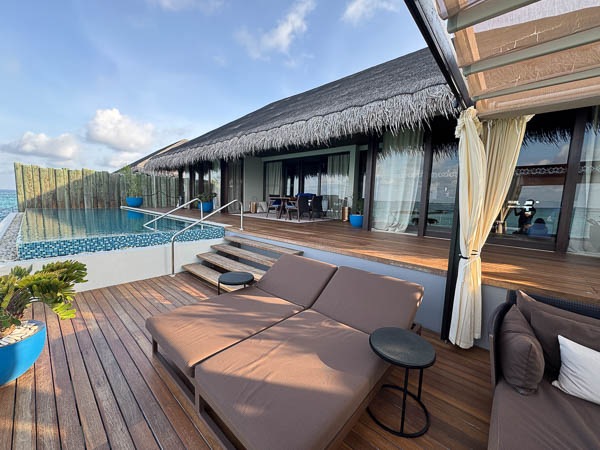
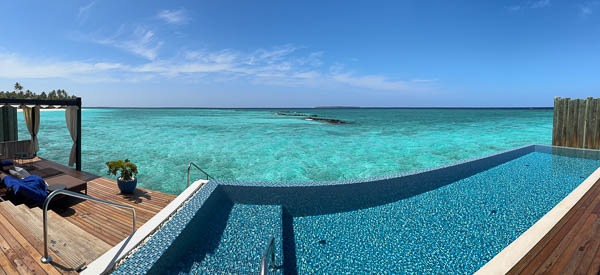
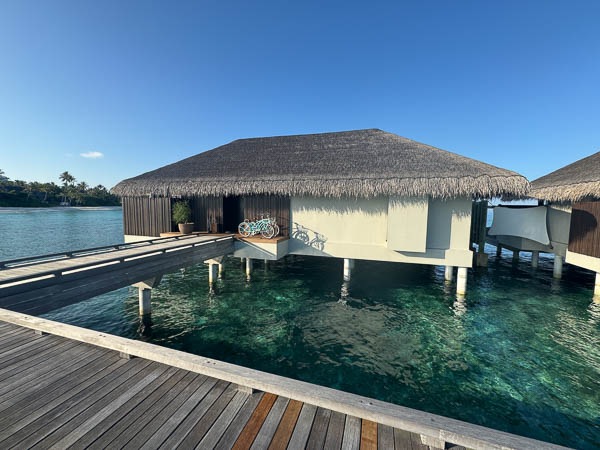
Since this was our first trip to the Maldives, we felt somewhat obliged to stay in one of the over-water villas. We chose a "sunset view" villa, which was lovely. It was amazing to be able to step off our deck right into the ocean. The villas were stunning: perfectly appointed and comfortable, with lots of great places inside and out to hang out. Next time, we might try a beach villa, just to provide a little more shade under the trees to stay out of the unforgiving sun and to be able to enjoy the sand.

Our villa front and back:
IMG_5020

IMG_4969

IMG_5329

We were really blown away by the variety and quality of food. This is especially important because you really can only eat at the resort's restaurants since the resort takes up the entire island. It's not like in Hawaii where you can leave your resort to go to other restaurants. Their menus were extensive, covering various European, East Asian, South Asian, and Middle Eastern cuisines. Normally, big menus are a red flag since it's hard to do such a diverse menu well, but Velaa pulled it off. They apparently have chefs from fourteen different countries. One night, there was an international buffet with Italian, Uzbek, and Chinese stations. The Chinese station was authentic with good roasted Beijing duck. We enjoyed the Uzbek station too; our Kazakh waitress told us Kazakh food was almost identical and vouched that the plov (rice and lamb dish, sort of like biryani or pilaf) was legit and just like at home. I enjoyed the bit of Maldivian (also known as Dhivehi) cuisine they had available. In particular, I liked the mas huni (a breakfast dish made of shredded smoked tuna, grated coconut, onions, and chili - sort like a uplevelled tuna salad) and the Maldivian reef fish curry (coconut-based, more like Indian than, say, Thai.)

The GM advised us early in our stay to make sure we visited Faiy, their wellness restaurant. We gave him a questioning look, but he insisted it was fantastic. He was right; it was absolutely amazing. Aragu, their fine dining restaurant was also stunning as was Athiri, their all-day restaurant where we took most of our meals. The only restaurant that we thought was only OK was Tavaru, their teppanyaki restaurant. It was fine, but the set meal was just too much food, and it wasn't particularly memorable.

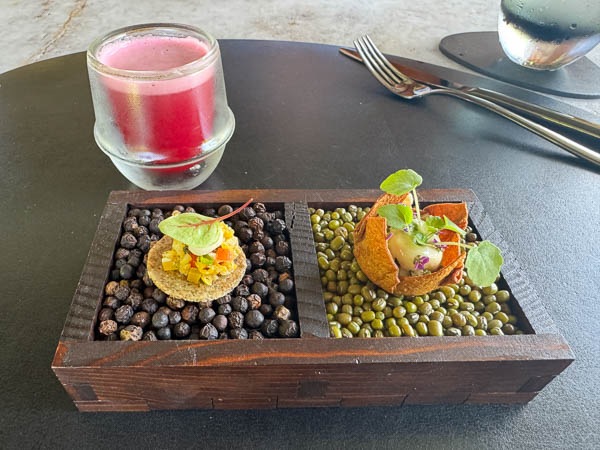
Amuse bouche at Faiy:
IMG_5210

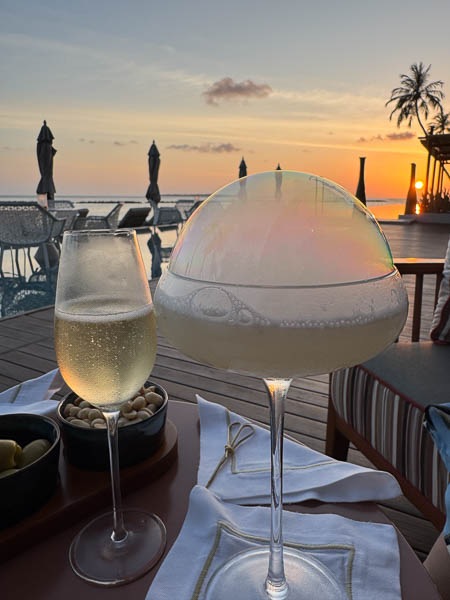
Perhaps more surprising, their cocktail program was really exceptional. The drinks were creative and well-balanced - simply delicious. It was hard to pick a favorite from their huge menu of house cocktails, but if I had to pick, the "Tokyo Glamour" was prob the top for me, described as "Rokku Japanese gin, fruity sake, lychee puree, lime juice, kaffir lime infusion, and a shot of Champagne on the side". They omitted the cool smoke-filled bubble on top.

The Tokyo Glamour:
IMG_5295

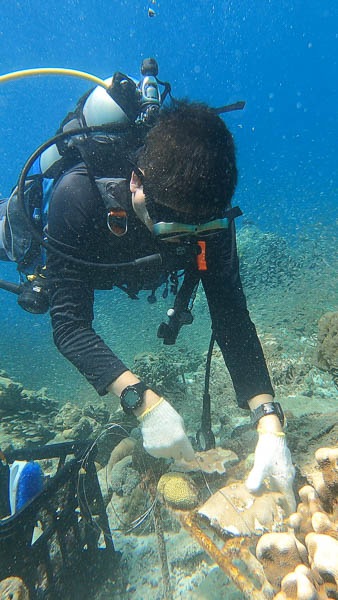
There was no shortage of activities. During the trip, I took advantage of the spa, tried my hand at e-foiling (electric surfboard that gets up out of the water on a wing - I did manage to get the board out of the water and ride it. Fortunately, there are no known photos or videos of my attempts though), took two golf lessons at their slick little Troon-owned par 3 course, and did two SCUBA dives (the first in many years). One cool thing about Velaa is that they have a coral reef science program that is restoring their reefs. Michelle and I got a private talk from their marine biologist, and then I did a dive with the biologist to do some of the restoration work (mostly tying loose live coral onto their cool BioRock reef).

GH017719-1

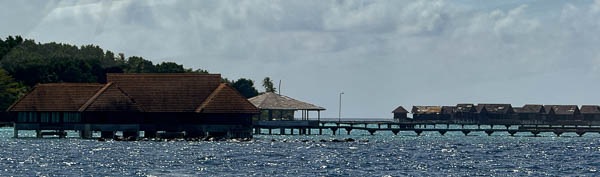
I also did a dive at the nearby "Ghost Island" where the 80% completed Mandarin Oriental resort has been abandoned for the last fifteen or so years after the local partner ran out of money. The staff told us that the villas have mattresses in bags and toiletries on the shelves already but the roofs and glass are broken on many of them. The economics of restoring the resort are apparently bad compared to the cost of just building a new island resort, so it seems unlikely they'll find a buyer. It did mean the reef was largely undisturbed, which made for good diving though, complete with white and black-tipped reef sharks, barracuda, and huge lobsters.

The resort buildings (left) and over-water villas of "Ghost Island" - note the collapsing roofs on the villas.
IMG_5228

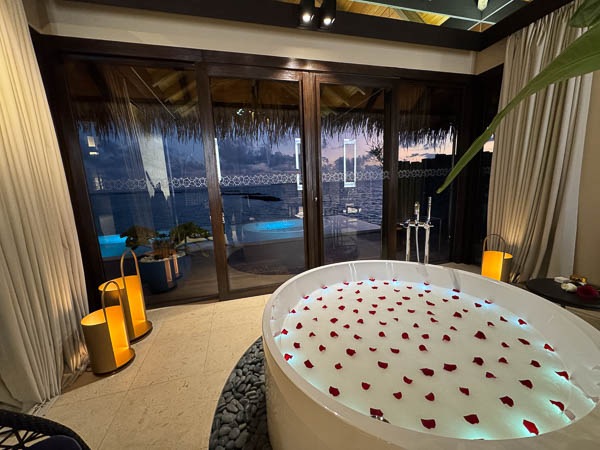
Service across the board was truly excellent, most notably from our butler, Yasir. He was always available, leaving thoughtful treats and doing nice things like drawing baths. Everywhere we went, we were greeted kindly and often met with cold towels and drinks (which were especially welcome on the golf course and after my e-foiling efforts). Yasir and some of the other staff mentioned how much they enjoyed working at Velaa relative to other resorts they have worked at. They live on the island in the village in the middle of the island for a few weeks (or months) at a time and then go home on vacation to the island (or country as appropriate) for vacation. It sounds like the owner really takes care of the staff well, which showed in how attentive and happy the staff seemed.

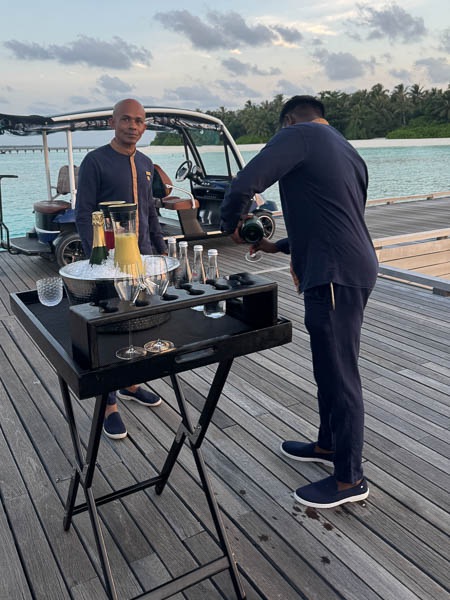
Meeting Yasir for the first time at the floatplane arrival dock, complete with Champagne welcome.
IMG_4952

The rose-petal covered bubble bath that Yasir had drawn for us, ready for our arrival.
IMG_4954

A few practical matters and observations: From Seattle, we flew fourteen hours to Doha, Qatar on Qatar Airlines. We stayed in Doha for a few days (which I'll write about later). We then took a four hour flight to Male, the capital of the Maldives. From there we waited a few hours in the seaplane terminal (Velaa and the other big resorts have club lounges) for a floatplane to take us the 45 minute flight to Velaa.

We were initially considering going to Tahiti or Fiji, but after some research we learned that while the resorts there lovely, the food is only OK in general. Maldives was generally considered to have better food all up, so we decided on Maldives. We normally lean toward great resort chains like Mandarin Oriental, Four Seasons, Ritz Carlton, or Rosewood, but we thought their offerings mostly looked the same as their other properties anywhere in the world. It turns out that we really like these privately owned resorts where the founder's vision infuses the place. Velaa and Pulau Pangkil are both passion projects where the owners seem more interested in fulfilling their vision rather than reaping profits. We'll definitely seek other such resorts in the future - that is if we ever go anywhere else besides Velaa on future vacations. It's pretty amazing.

OK, trying again

  • Published Date:
  • by
  • Category:

I'm still alive. I had some technical problems with my blog hosting for a while so I couldn't really post. I think I've cleared up the biggest barriers with a little help from ChatGPT, but I still have a little more to do. I hope to start sharing more here again, so stay tuned as I work this out!

Burgers: In-N-Out

  • Published Date:
  • by

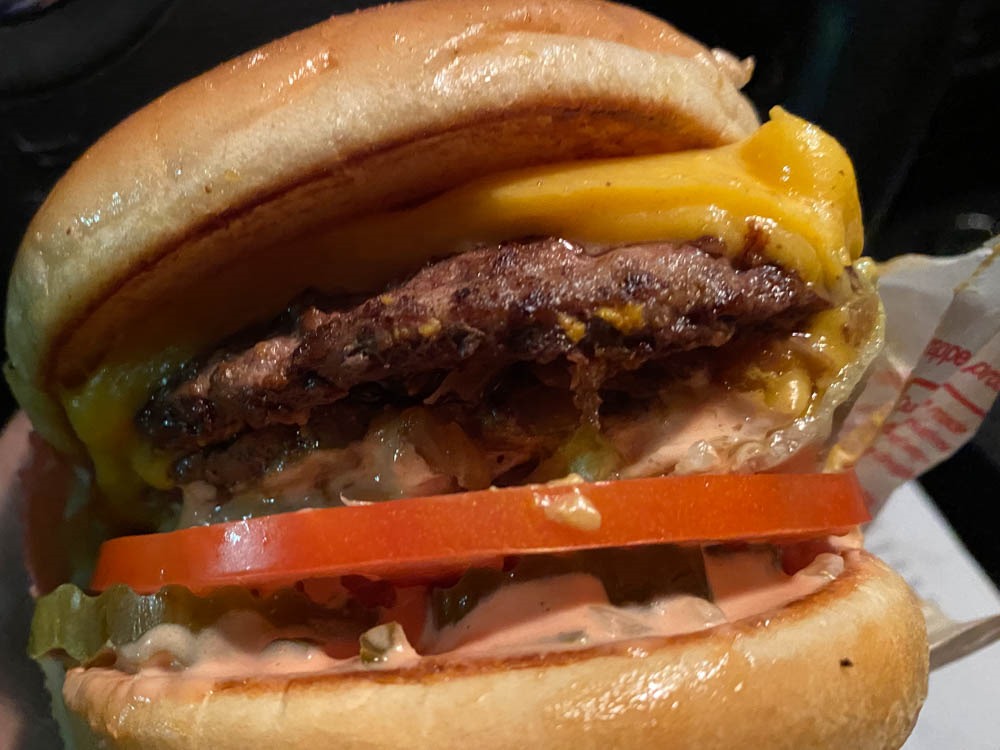
Probably the number one question I got from my friends during and after the burger trip Andrew (24) and I took is "how does In-N-Out Burger compare?" (Interestingly, no one asked me how Shake Shack compares, despite the rivalry between the chains.) So, when I was visiting Michael (21) at college near Denver, we stopped at an In-N-Out in Lakewood, CO. We both ordered the Double-Double Animal Style burger of their "not so secret menu". This is a burger with two patties, two slices of American cheese, lettuce, tomato, "spread" (Thousand Island dressing), pickles, and grilled onions. The thing that makes an Animal Style burger special is that patties are grilled with yellow mustard, so you get a cooked mustard taste. In-N-Out also grills their buns so they're crispy inside.

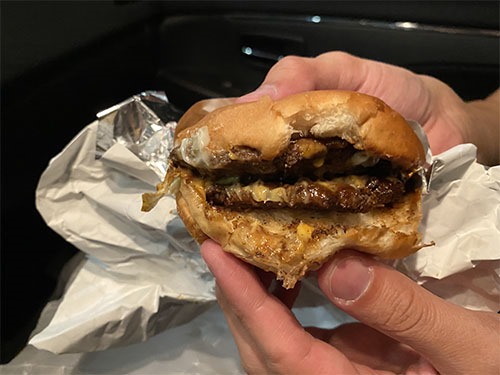
Closeup of a double cheeseburger with a slide of tomato, pickle chip, and Thousand Island dressing visible.

My family has loved In-N-Out for a long time, but this was my first visit after diving so deeply into burgers. Fortunately, In-N-Out still holds up. The burger was pretty damn good. The grill mustard really adds a fantastic flavor and the grilled bun is great (similar to the Culver's Butterburger in the Midwest). The meat was OK-well seasoned; a little more salt would have helped, and the patties were a little dry. All-in-all, it was a very satisfying burger, especially for a larger chain restaurant. Unfortunately, the fries are meh at best. I ordered mine "well-done" (extra crispy), and Michael had his regular. Both were a little flabby and boring. Still I wish we had them in the Seattle area.

I'd put them at the top of the fast food burgers because of the grilled mustard, maybe tied or just ahead of Kewpee Hamburgers in Ohio. I still prefer the Double Tavern Burger at Loretta's Northwesterner, a pub in Seattle (Andrew, his girlfriend, and I just went back there again over Christmas break -- still delicious). I need to try Shake Shack again soon (fortunately, we do have them in Seattle.)

Burgertrippers: Retrospective

(Read the intro post for background on this trip.)

Well, we made it, and Andrew (24) is safely ensconced at the Culinary Institute of America now. Across our entire burger trip, we ate 24 different burgers including the two we had in Seattle as a baseline a little before our trip. (We also had four Philly cheesesteak sandwiches.)

Our three favorite burgers were:

It's worth noting that these burgers are all pretty different, so they're a little hard to compare. They're just the burgers we wanted to order more of and kept talking about afterwards. I'd also call out the Bear Bite Burger at the Shoshone Lodge outside of Cody, WY and the plain burger at Louis’ Lunch as other burgers we kept talking about afterwards.

Our least favorite burger was the Galley Burger at Swensen's Drive-in in Columbus, OH. (The elk and bison burgers at Iron Horse Bar & Grill in Gardiner, MT were also nothing special, but those were in a different class and were not a destination burger for us.)

For the chain restaurants, we loved the cheeseburger at Kewpee Hamburgers in Lima, OH. We were split on White Castle (they weren't as good as I remembered, but Andrew was entranced by something about it) and Culver's (I loved them but Andrew was turned off by how much mustard his had.)

In truth, all of the burgers were acceptable or better; none were bad.

Across all these burgers, we realized a few things:

  • A lot of burgers are really about the toppings, with the patty mostly providing texture and warmth. I think this is why you can have a decent burger experience with a veggie patty. Incrediburger in Spokane is a good example of this -- creative and tasty toppings and a good bun, but the meat didn't add much in terms of flavor. It was still a good burger.
  • Our favorite burgers had the meat as the focal point -- beefy taste, at least half of the volume of the bite, well-seasoned. The classic burger at Louis' Lunch is the epitome of this fact -- great meat on a toasted bread with nothing else. Delicious, like eating a steak sandwich. We liked burgers with a good char on the outside, like a smashburger. In most cases, we think a double is the way to get the right meat/bun ratio. Medium rare, of course.
  • We both liked cheese on our burgers, usually American. In most cases, the cheese becomes a sauce for the meat. This was particularly true when the cheese was in the meat, like the Jucy Lucy and Juicy Nookie burgers in Minneapolis. (Cheese inside the patty mixed with the juices to make a terrific sauce.) When it's not melted (like at Culver's) it wasn't nearly as good. However, on two burgers (Bernice Original at Shady Glen in Manchester, CT and the single burger at Ted's in Meridian, CT) the cheese was its own element. In each of these cases, the cheese was thick enough that it had a distinct flavor and texture that changed the burger (for the better). This was especially true with the Bernice Original where the cheese was cooked until it crisped up. Both ways are great.
  • We were divided on toppings. We liked onions, either grilled or raw. We'd like to try a mix of both. We were both ok with lettuce. I liked tomato if it's a good tomato; Andrew thought it didn't add anything. I liked thin pickle chips on the burger to add some acid; Andrew liked his on the side to prevent the pickle from overpowering the flavor. Surprisingly, we were both ambivalent about bacon on the burger.
  • One note, we realized that we didn't like toppings that were long and could be pulled out of the burger, like rings of onions or slices of bacon. It was no fun fighting the toppings, plus then you either got too much of something or not enough. We liked diced onions better, so every bite was consistent. The one exception was the piles of onions on the burger at Powers in Fort Wayne, IN. That was basically an onion burger -- half onion and half burger. Super tasty, just different.
  • We were divided on condiments too. On the best burgers, we didn't need any condiments (e.g. Louis' Lunch). I like ketchup, mayo, and mustard. Andrew just wanted ketchup. Barbecue sauce was a nice addition if it added a little acid to cut the fat, but the ones that were too sweet overpowered the burger.
  • We both agreed we liked the buttered and toasted buns of Culver's Butterburger -- great flavor and crunch. We both thought brioche buns were too soft and fragile for burgers; they just disappeared. We liked something with a little more substance to hold together as we ate the burger. Sourdough can help balance a strong burger, and ciabatta-style rolls held up well.
  • There was some pairing to explore with drinks and burgers. We didn't come to consensus on when Coke, beer, or a shake was best or what kind of beer or shake matched what circumstance. We liked the balance from the acidity in Coke, the way alcohol in beer washed away the fat, and how a creamy shake complemented the richness of the burger. We didn't even delve into the wine side at all -- something for another time.
  • We were pretty disappointed with the fries across the board. Most of them were the same frozen fries cooked in vegetable oil. (Still tasty, of course.) Incrediburger in Spokane was an exception with their beef fat fries. Loretta's in Seattle has good, handcut fries too. And, Matt’s Burger in Minneapolis must have sprinkled crack on their frozen fries; we ate every last fry out of a huge basket – just well executed frozen fries, I guess.

I want to try combining these lessons to make the Ultimate Burger. Stay tuned.

And, because several people have asked, I gained four pounds on the trip. I have mostly lost that since coming home

Here are a few other observations from the trip. Nearly every restaurant, hotel, and gas station we went to had signs saying they were hiring. As I noted, the best breakfast place we went to (Bearlodge Bakery in Sundance, WY) was serving their last breakfast before closing because the owner couldn't find enough help. It's one thing to read about the challenges businesses face hiring; it's another to really see it everywhere.

East of Seattle, there were very few people wearing masks, except where required like in US Federal buildings in National Parks or indoors in cities with mask mandates like Chicago. Masks picked up again in New York. No one said anything to us since we were wearing masks, but we stood out. I think the social pressure to be like people around you has a snowball effect -- either nearly everyone wears a mask or nearly no one does.

It's easy when you live in a biggish, coastal city like Seattle to dismiss the "flyover" states, maybe with exceptions for big cities like Chicago. However, I was really pleasantly surprised by how nice smaller cities like Spokane, WA and Sioux Falls, SD are. I'd love to spend more time in Philadelphia too (big city there, of course). I was also amazed how good the museums in Cody, WY and Dayton, OH were. I really want to go back and spend more time in those. And, I am impressed with how my hometowns of Minneapolis/St. Paul, MN have revitalized. I love spending time there. It was really great to remind myself how awesome the United States is and that each part has uniquely cool things to offer.


The List

Seattle, WA
Loretta's Northwesterner

  • Double Tavern Burger
  • Deluxe Burger

Spokane, WA
Incrediburger

  • PB&J Burger
  • Classic Burger

Gardiner, MT
Iron Horse Bar & Grill

  • Elk Burger
  • Bison Burger

Cody, WY
Shoshone Lodge

  • Bear Bite Burger

Rapid City, SD
Sickies Garage Burgers & Brews

  • Sickie's Burger
  • Classic Cheeseburger with Kobe beef

Sioux Falls, SD
Culver's

  • Butterburger

Minneapolis/St.Paul, MN
White Castle

  • Cheeseburger

Casper & Runyon's Nook

  • Juicy Nookie
  • Triple B (Bourbon Bacon Burger)

Matt's Bar

  • Jucy Lucy

Davenport, IA
Maid-Rite

  • The Cheese-Rite
  • The Original Maid-Rite

Chicago, IL
Au Cheval

  • Single burger (plain)
  • Single burger (w/ bacon and egg)

Fort Wayne, IN
Powers Hamburgers

  • Doubles with cheese

Lima, OH
Kewpee Hamburgers

  • Cheeseburger

Columbus, OH
Swensen's Drive-In

  • Galley Burger

New Haven, CT
Louis' Lunch

  • Hamburger (plain)

Meridian, CT
Ted's Restaurant

  • Single cheeseburger with everything

Manchester, CT
Shady Glen Dairy Stores

  • Bernice Original

Burgertrippers: Day 12 Last burgers and the end of the road

(Read the intro post for background on this trip.)

What a difference a day makes. After driving through the rain all day yesterday, Andrew (24) and I were happy to see blue sky today. We left Philadelphia, Pennsylvania early this morning for our last day of driving and last planned burgers. We hit nearly standstill traffic getting to the George Washington Bridge near New York City. Once we got clear, we headed to New Haven, Connecticut. We visited the beach to be by the Atlantic Ocean, mirroring our start where we put our hands in the Pacific Ocean (Puget Sound). Unfortunately the tide was out when we went to the Atlantic, so we couldn’t get past the mud flats to the water.

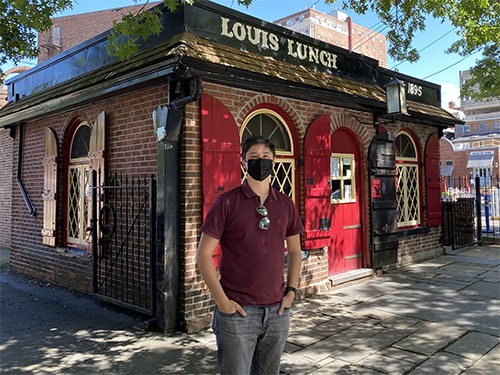
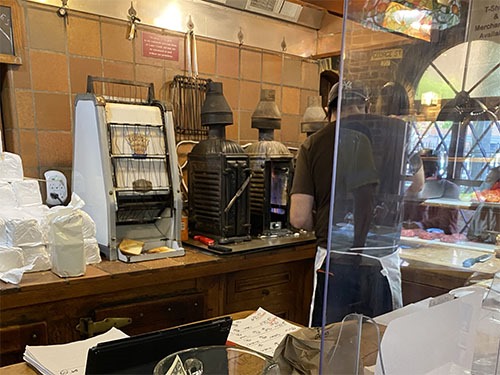
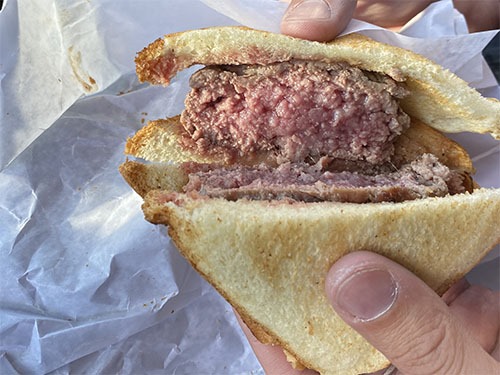
We had three burgers planned today, all big ones that we were excited about. The first was Louis’ Lunch in New Haven, in the shadow of Yale University. Louis’ has been in business since 1895 and is the birthplace of the hamburger sandwich. They ground the meat themselves fresh daily from five cuts of beef then broil them in a proprietary vertical cast iron cooker they invented. The burgers are then served on white toast. They only offer them plain or with Velveeta, grilled onions, and tomato. They make a big deal about not allowing ketchup. Since we were going to have so many burgers today in a short time span, we split one basic hamburger with no toppings – their original. With only meat and bread, the burger tasted almost like a good steak sandwich. The patty was medium-rare, leaving it quite juicy. It was pretty well seasoned, although I would have liked a little more salt. The toast was a little thin for the thick patty, but since it’s sourdough the toast stood up flavor-wise. I wish we had tried one with cheese, onions, and tomato, but this one was really good. It’s not hard to see why they’ve survived and thrived for so long.

Andrew outside the Louis’ Lunch building.
Andrew standing outside a very small, old brick building with the sign Louis' Lunch and  red door.


You can see the unique cast iron cookers here. The patties are attached to a vertical tray that is inserted into the cooker where it’s cooked with flame on both sides. The bread is toasted using the machine on the left.
The cooking area behind the bar. Three old looking cast iron cookers are in the middle. A continuous toaster is the to the left. The cook is working in front of the cookers.


Look how thick that patty is! It’s really a simple burger, but tasty. 
Two halves of a cut burger on white toast. The patty is very thick and almost rare in the middle.


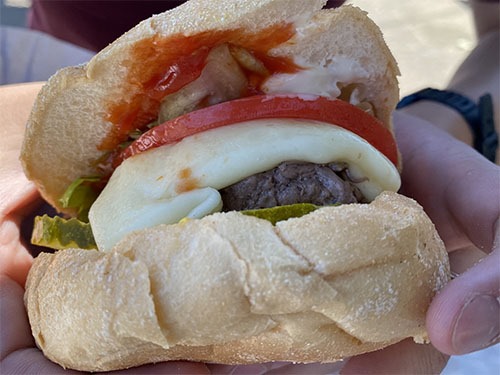
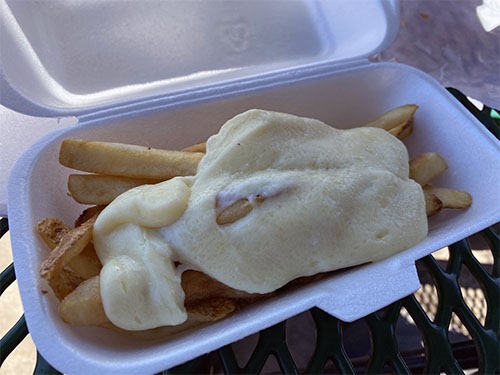
After Louis, we drove about 30 minutes to Ted’s Restaurant in Meridian, Connecticut. Ted’s is famous for their steamed burgers. They steam the meat instead of grilling it. They also steam the cheese. We ordered single cheeseburgers with everything (tomato, onion, lettuce, pickle chips, ketchup, mayo) plus their cheese fries. This was a unique, tasty burger. It was well-proportioned and well-balanced. The steamed Wisconsin cheddar plays a particularly big role in this burger. It adds salt and flavor, but it’s also thick enough to add texture and chew to the burger. The steamed meat tasted good and was more tender than most of the grilled patties. The cheese fries were a bit of a bust; the cheese had cooled into a solid sheet over the fries. We had to tear chunks of cheese off to eat with a fry (which was good). A very enjoyable burger, although I doubt we’ll be steaming burgers at home.

Thick almost puffy burger closeup with a lot of cheese, ketchup, and a slice of tomato. You can barely see the meat under the whitish cheese.


 A styrofoam clamshell box full of fries covered in a thick sheet of cheese


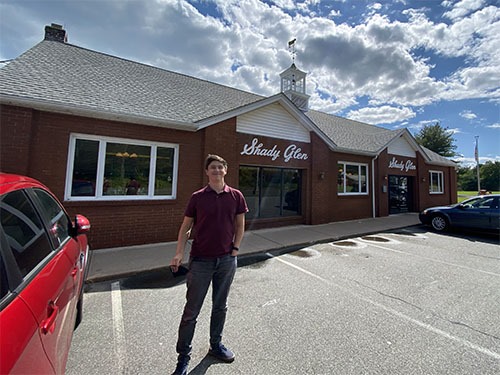
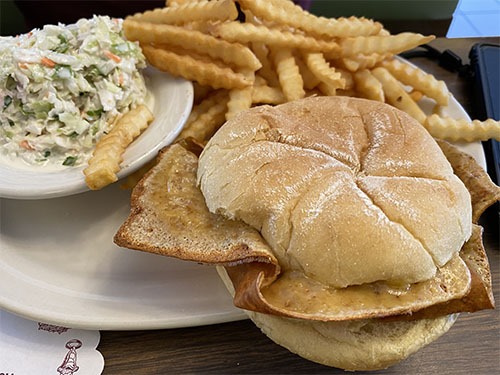
The last burger of our trip was another 30 minute drive away to Manchester, Connecticut at Shady Glen Dairy Stores. Their claim-to-fame is the Bernice Original, a burger with four slices of cheese overhanging the patty onto the grill. The cheese cooks until it’s mostly crisp. Aside from the visual interest, cooking the cheese like that also changes the flavor. When Andrew and took the first bite out of each of our shared burger, our eyes were wide. It was a really delicious bite, and each bite afterwards was equally good. The crisped cheese added a savory and unique flavor as well as some texture. The meat was well-seasoned and cooked well. Just delicious. The coleslaw, which came with the platter, was very good too, kind of KFC-like with a fine dice and a slightly sweet dressing. The fries were fine. Since Shady Glenn started as a dairy, we tried their milkshakes and were not disappointed. Super good. The only real problem was that this was our 3rd burger in 90 minutes, so we didn’t have room to eat more. Although they apparently make this cheese specially for the Bernice Original, I want to try cooking my cheese this at home too. This was probably our second favorite burger on the trip, after the Jucy Lucy at Matt’s Bar in Minneapolis. What a great way to end our burger tasting on this trip! We’ll summarize our burgers and lessons later.

Andrew outside a neat, 1950s looking brick restaurant with "Shady Glenn" written in white cursive over the door.

A platter with a burger, fries, and a small dish of cole slaw. The burger has browned, crispy cheese sticking out.

Image of the burger sliced in half. The meat is medium rare, the bun is prett flattened. There is cheese above and below the patty.

After we staggered out of Shady Glen, we completed our drive and arrived at the Culinary Institute of America. More on that later. We have a day of getting his last few things and exploring the area, then I drop Andrew off tomorrow and head back to Seattle.

Burgertrippers: Day 11 Philly Cheesesteaks

(Read the intro post for background on this trip.)

Today was a tough drive. Andrew (24) and I were on the road for almost nine hours going from Columbus, Ohio to Philadelphia, Pennsylvania. The remnants of Hurricane Ida were beating down on the area, so it rained hard all day. We received tornado watch/warnings and flash flood watches too. We decided not to stop at all, which was a bummer since I had hoped to pay our respects at the Flight 93 National Memorial, especially since it’s just a few days until the 20th anniversary of 9/11.

Today was also a no-burger day for us. Since we are spending the night in Philadelphia, we decided to sample the Philly cheesesteak sandwiches instead. We decided not to brave the bad weather, so we had cheesesteaks delivered from three restaurants to our hotel instead. We chose Pat’s King of Steaks (the original), Geno’s Steaks (across the street from Pat’s and almost as well known), and Jim’s South Street (a favorite among locals). We knew these would be less tasty after waiting to be delivered vs. eating there, but it was a good way to try more of them easily (and stay out of the bad weather.

From each restaurant we ordered cheesesteaks with onions, peppers, mushrooms, and whiz (Cheese Whiz – a classic choice). We also got one sandwich with provolone instead of whiz from Pat’s.

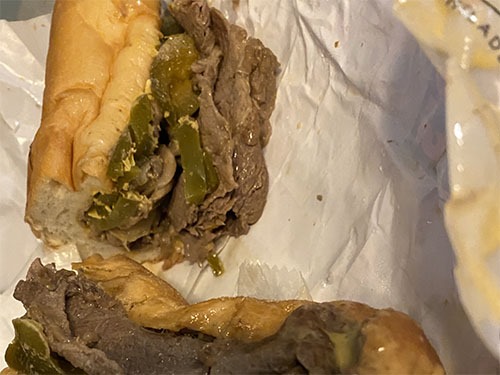
We were pretty surprised how different the three sandwiches were, especially since they apparently all get their bread from the same supplier. Pat’s was pretty disappointing. The meat was flavorless and dry, and there wasn’t much of anything in the bun – less meat, toppings, and cheese than the other restaurants. The bun was stale to boot. We couldn’t tell too much difference between the whiz and provolone versions since there was so little cheese in the sandwiches.We didn’t even finish these.

Whiz and provolone sandwiches from Pat’s. Notice how sparsely filled these are and how dry the buns are.
two thin cheese steak sandwich halves


The sandwich from Geno’s was much better. It had more cheese and toppings, and the meat had more flavor. The bun was damp with cheese and the juices from the meat, which was delicious. This was Andrew’s favorite.

Geno’s sandwiches. Notice how much more filled the sandwich is and how much more the buns have soaked up cheese and juice vs. Pat’s.
Two halves of a cheesesteak sandwich, more filled than than the one from Pat's. The bun is squished a bit.

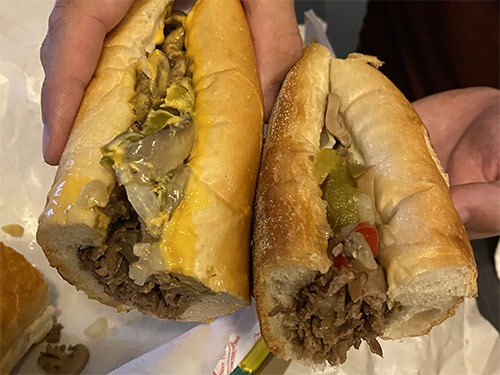
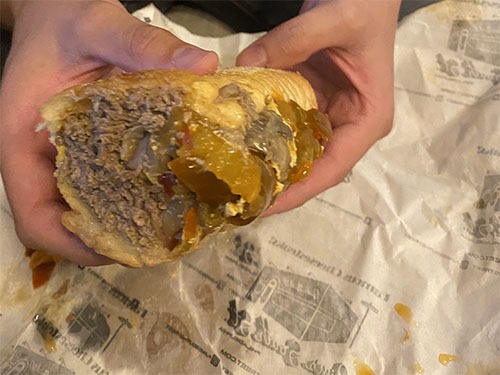
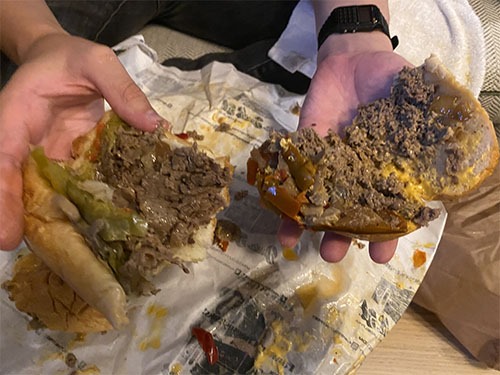
The sandwich from Jim’s had much more meat than either of the others. The meat was also much more finely chopped vs. the others, which were more sliced. I thought their toppings were better than the other two places too, although Andrew wanted more cheese on Jim’s. I thought this was the tastiest sandwich and was my favorite.

Look how much more meat there is in the sandwich from Jim’s. The bun is also soaked with flavor…
Cross section of a really filled cheesesteak sandwich. The bun is completely squished down around the meat.


You can see how much more chopped up the meat is on the sandwich from Jim’s (right) vs. Pat’s (left).
Two cheesesteak sandwich halves, open. The one of the left has slices of beef. The one on the right has almost chopped beef.

It turns out the topic of who has the best cheesesteak in Philadelphia is something of a hot topic, bordering on religion. Pat’s and Geno’s are the best known and have the most tourist attention. There are a lot of other restaurants that also have cheesesteaks here (like Jim’s). I didn’t realize there was so much variation. We’ll have to come back and try more. Hopefully, there won’t be a hurricane, tornadoes, and flooding next time.

Burgertrippers: Day 10 Three burgers from Chicago to Columbus

(Read the intro post for background on this trip.)

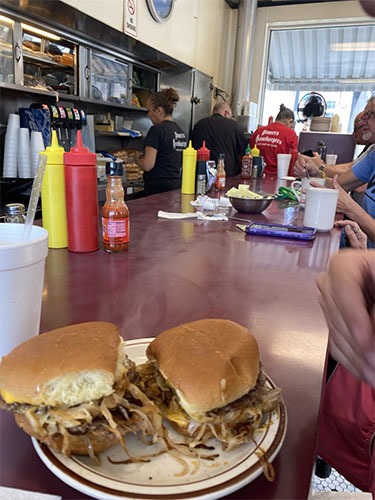
Today was our first three burger day as we drove from Chicago to Columbus, Ohio. The first was at Powers Hamburgers in Fort Wayne, Indiana. The first Powers was opened in 1935; we went to the only surviving location, opened in 1940. This is a little shop with counter seating. As soon as you walk into the restaurant, you’re hit with the smell of grilled onions. The burgers are small, just bigger than a slider but smaller than a McDonald’s cheeseburger. The thin smashburger patties are covered in thinly sliced, grilled onions; these sit on a steamed locally made bun. We had doubles with cheese.

Two small burgers with piles of onions coming out from under the bun, sitting on a plate, on a diner counter. The restaurant staff is busy in the background.

These were really good. Well-balanced and tasty; the onions were a major part of the texture but were not overwhelming. The buns were soft. It’s what White Castle should be, frankly. The place was loaded with regulars; the older guy sitting next to me had been coming since he was a kid and clearly had a lot of fond memories when the restaurant used to be a 24 hour operation, coming in on the last stop on the way home after a night out. Enjoyable burger and stop.

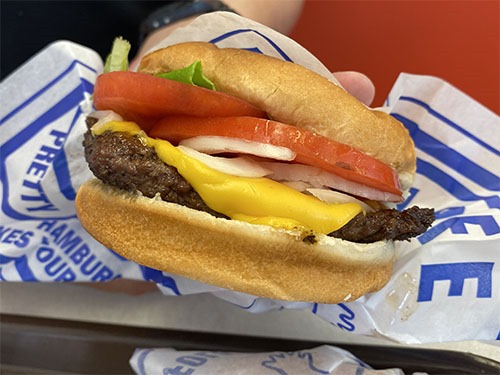
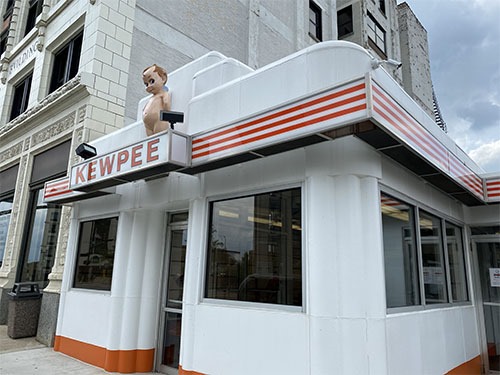
We drove into Ohio and stopped in Lima to visit Kewpee Hamburgers, the second oldest burger chain in the country, after White Castle – founded in 1928. We visited the original downtown location. The burger had a loosely formed patty and topped with American cheese and the standard fixings. We opted out of fries here since we had just had the Powers Burgers not too long ago. This was a really good, solid burger. I thought the bun was especially tasty. We probably should have ordered doubles to improve the meat-to-everything-else ratio. This was probably the closest to an In-And-Out burger that we’ve had on this trip so far.

Close-up of a cheese burger with tomato, lettuce, and onion.

A small white square art deco building with a Kewpee sign and a Kewpee doll over the sign.


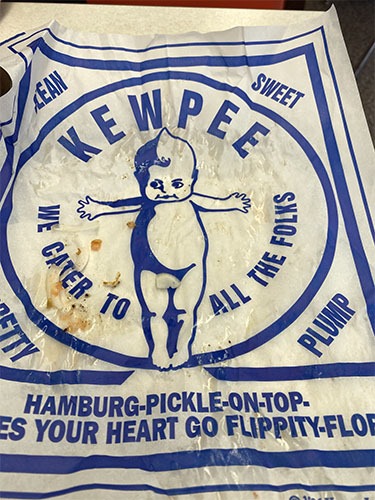
Kewpee burger wrapper with a picture of the doll. The text says "Kewpee - We cater to all  the folks" and "Hamburg-pickle-on-top makes your heart go flippity flop"

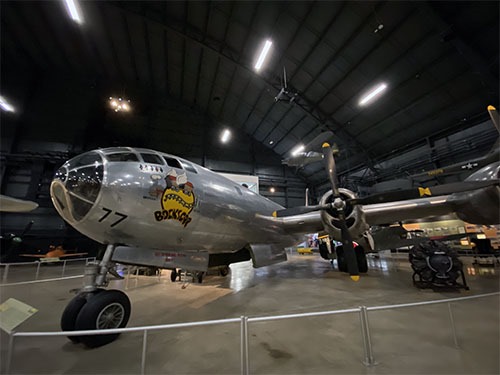
We headed to Dayton, Ohio next to visit the National Museum of the US Air Force. This is the world’s largest military aviation museum. Unfortunately, in my planning I forgot that we’d lose an hour when we crossed into the Eastern time zone; we also got a late start out of Chicago. This meant we only had an hour to see the massive museum. Still, I was excited to see planes I’ve never seen before, like a Twin Mustang and an F-22 Raptor. They also had historically significant aircraft like Bockscar, the B-29 that dropped the second atomic bomb, on Nagasaki Japan. I really want to come back here. The whole area has a lot of flight-related museums and history since the Wright Brothers were from this area.

3/4 shot of the front of B-29 bomber Bockscar.

We finished the day up at Swensens Drive-In in Columbus, OH. This is a regional/Ohio-only drive-in burger chain founded in 1934. They are famous for their Galley Burger – a double cheeseburger with two special sauces. Naturally, we got that, one “with everything” – mustard, dill pickles, and raw onions, and one without. We also ordered their potato puffs – shredded fried potatoes. We wanted to try their potato teezers – potato/cheese/jalopeno combo but they were having supply chain problems and didn’t have them. We tried the substitute – fried mac and cheese balls. We also had their shakes. Frankly, I was disappointed. The burgers were reasonably well constructed and seasoned, but one of the special sauces tasted like a too-sweet barbecue sauce that overwhelmed everything. It was fine but not special. The potato puffs were just tater tots; I felt deceived. The mac and cheese balls were good but not special as were the shakes. Maybe we were just burgered out after our third round for the day, but we were unexcited about this dinner.

Close-up of a double cheese burger


Burgertrippers: Day 9 Iowa and Chicago

(Read the intro post for background on this trip.)

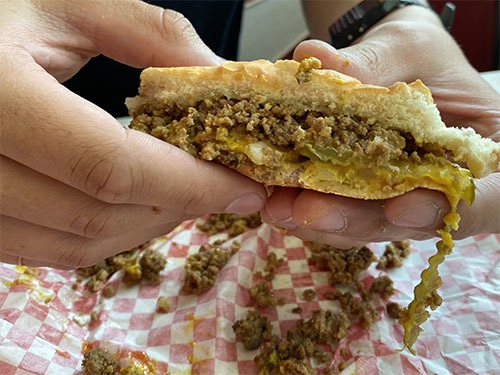
After our detour to Riverside, Iowa to see the Future Birthplace of Captain James T. Kirk, we stopped in Davenport, Iowa to visit a Maid-Rite restaurant. They are known for their loose meat sandwich. This is basically a burger where the beef is seasoned and cooked loose like taco meat rather than being formed into a patty. The chain has been around since 1926. Aside from the loose meat, the sandwich is set up like a burger with the same condiments, bun, etc. We had one with cheese and one without. It tasted a like a decent burger. The meat was well-seasoned and the bun-to-meat ratio was fine. The one with cheese was better since the cheese added some creaminess and mouthfeel that the other one lacked; the loose meat was all cooked to well-done. Not surprisingly, the sandwich was kind of a mess to eat too. We’re glad we tried this, but it’s not something I’d drive a long way for again.

Close-up of a messy burger with browned ground meat falling out.

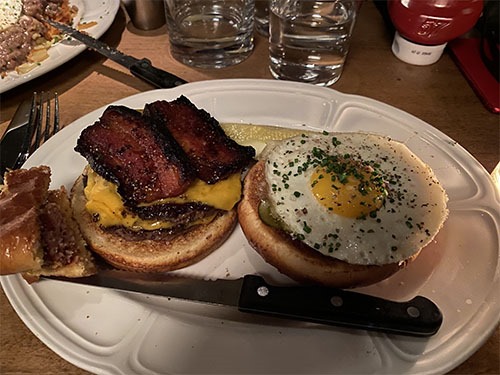
We then drove on to Chicago and went to Au Cheval with my cousin Eric, his wife Melody, her sister Alexa, and Yuri, a friend of Eric’s who was staying with them. Au Cheval has regularly been named the best burger in America, so it was a must-visit on our trip. We had their single cheeseburgers (which are really doubles), one plain and one with bacon and egg. They were gorgeous – really lovely to look at (and post on Instagram). Easily the best looking burgers we’ve had on the trip so far.

Open burger on a plate with two thick strips of bacon topping one side and a fried egg topping the other side.

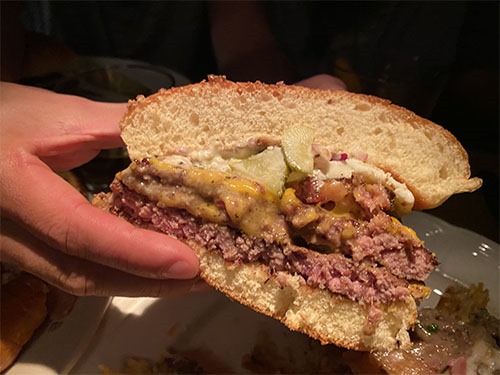
Cross section of a double cheeseburger

These were smashburgers on a toasted brioche bun. The meat was well-seasoned and well cooked, still tender. It was very good, but honestly, I’m not sure how it could have lived up to the “best burger in the country” hype.  Andrew is convinced that brioche is the wrong type of bread for a burger since it disappears into nothingness; I’m starting to agree with him. The bite wasn’t as unctuous as the Jucy Lucy we had in Minneapolis; it wasn’t even as straight-forward tasty as the Double Tavern Burger at Loretta’s Northwesterner in Seattle. Andrew didn’t even finish his burger.

By contrast, he wanted to order another Jucy Lucy after he ate the first one (he would have but it takes a while to get one and we were with friends) and at Loretta’s we actually did get another burger. I really enjoyed it, but I actually liked some of their other menu items better. The foie gras with scrambled eggs and toast was decadent. The omelette was prepared perfectly – light, fluffy, and savory. And the fried bologna sandwich was like bologna sandwiches from my childhood memories kicked up 10000%.

The evening was super enjoyable. Good food and good drinks with family made for a super night.

Burgertrippers: Day 9 The Voyage Home Museum

  • Published Date:
  • by
  • Category:

(Read the intro post for background on this trip.)

This is a special non-burger post. Andrew (24) and I left the Twin Cities and headed down to Riverside, Iowa. They are the self-purported “future birthplace of Captain James T. Kirk” (from the Star Trek series). We actually re-routed our trip especially to come to Riverside since we’re both Star Trek fans (especially Andrew – observant blog readers will have seen the Star Wars comm badge he wears on his jacket – all of them.)

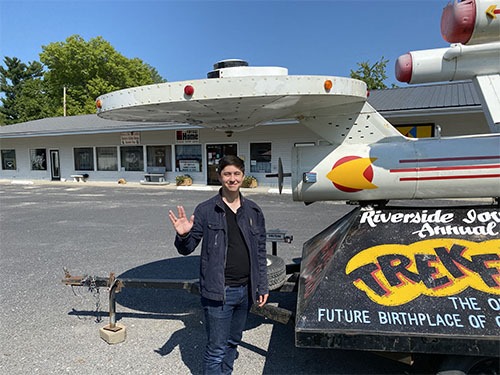
Andrew in front of the museum, standing by the USS Riverside parade float.
Andrew standing next to a parade float of a starship in front of a small stripmall museum. He is giving the Vulcan "live long an prosper" salute.


In the original Star Trek series, Star Trek creator Gene Roddenberry stated the Kirk was from Iowa but didn’t say where. Someone in Riverside decided that Kirk was born in Riverside and put up a little museum called the Voyage Home Museum. In 1985 the city petitioned Roddenberry and Paramount Pictures for permission to adopt Kirk as their “future son”, which was approved, so it became Star Trek canon that Kirk is from Riverside.

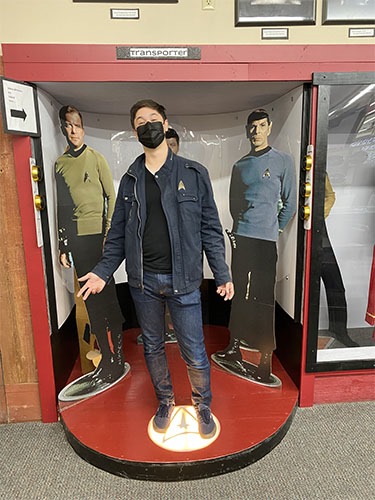
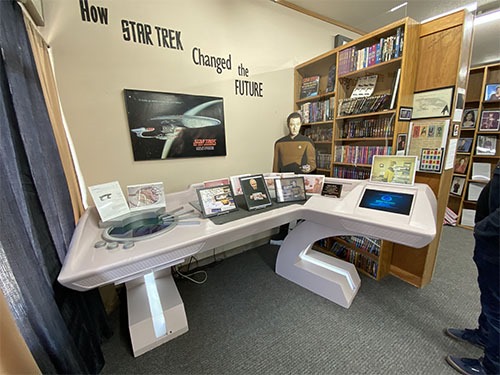
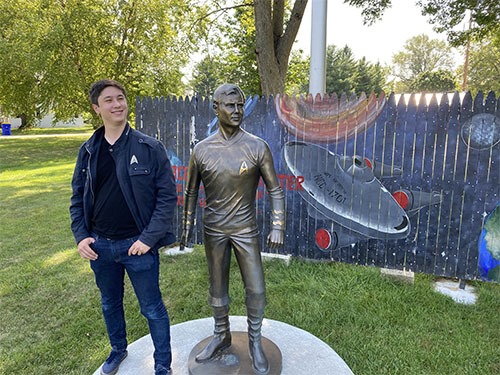
We were super disappointed when we pulled up to the museum to find it was closed. A sign on the door said they were closed due to lack of staff, but they did have a list of numbers to call to see if they could come let you in. The second number I tried resulted in a nice lady walking over (on her birthday no less!) to open the museum up. It’s a small museum stuffed full of Star Trek memorabilia ranging from actual props like Data’s desk from the Enterprise-D to self-built sets like the Enterprise bridge and transporter room. Super fun. They also have the “USS Riverside” (which looks a lot like the Enterprise) float for their annual TrekFest event and a bronze statue of Kirk across the street in a park.

Andrew in in a transporter bay. The buttons next to Kirk trigger red alert and other sounds.
Andrew standing in an original series-like transporter bay in front of cardboard cutouts of Kirk, McCoy, and Spock.

The original prop for Data’s desk in his quarters from Star Trek: The Next Generation.
.A Star Fleet desk with a cardboard cutout of Data behind and other pictures and books on top of it.

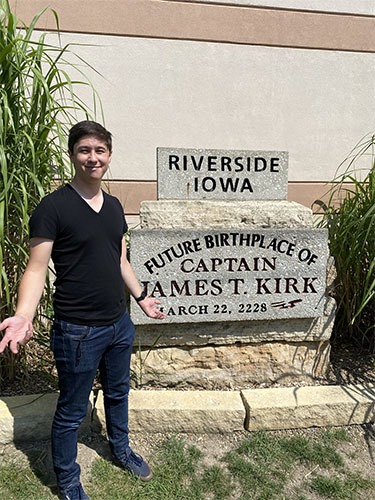
The whole town is in on this. Down the street there’s a stone plaque noting the birthplace.  The street lights have Star Trek pennants flying from them. There was a bar called Murphy’s Bar and Grill that claimed to be the future Shipyard Bar (where the fight scene in the new Star Trek movie takes place). They also have a plaque marking “Captain James T. Kirk conceived at this point on June 22, 2227”; it used to be under the pool table until a remodel, when they moved it to a wall. Unfortunately, the bar closed this summer due to COVID business impacts. I hope someone buys the bar and reopens it, or Kirk may never be conceived…

Anyway, it was a fun side trip on our journey.

Andrew standing in front of a stone plaque with inscribed with "Riverside Iowa. Future birthplace of Captain James T Kirk. March 22, 2228"

Andrew standing next to a near life-size bronze sculpture of Captain Kirk. Behind is a wood fence with a Star Trek mural